
nbc logo (2)
Office address
National Engineering Industries Ltd.
Khatipura Road Jaipur – 302006 Rajasthan, India
Phone Number

Toll Free: 1800 3000 6222
Telephone: +91 141 222 3221
Fax: +91 141 222 1926, 222 2259
CIN: U29130WB1946PLC013643

10 Best Axial Bearings for Industrial Applications

Axial loads rarely announce themselves with a dramatic failure. More often, vibration rises, lubricant darkens, or a shaft develops unwanted endplay. An axial bearing helps control these forces, but the right choice depends on load direction, speed, space, lubrication, and operating temperature. Small details matter.

The U.S. Department of Energy’s Improving Motor and Drive System Performance: A Sourcebook for Industry reports that motor-driven systems account for about 69% of electricity use in U.S. manufacturing. That figure does not measure bearing failures, but it shows why dependable rotating equipment matters to industrial efficiency. For engineers, bearing selection is one practical part of managing that equipment. ISO 281:2007 provides methods for calculating dynamic load ratings and rating life; actual service life can still vary with contamination, installation, lubrication, and operating conditions. Ratings are not guarantees.

This guide compares ten axial-bearing options for common industrial duties, from compact thrust ball bearings to robust thrust roller designs. It considers load capacity, speed suitability, alignment tolerance, maintenance demands, and typical applications. A bearing that performs well in a conveyor gearbox may be unsuitable for a high-speed pump. There is no universal winner. The rankings are a starting point, not a substitute for checking manufacturer data and the machine’s real load case. One overlooked measurement can change the recommendation.
10 Best Axial Bearings for Industrial Applications

Understanding Axial Bearings and Their Role in Industry

Axial bearings, often called thrust bearings, carry loads parallel to a rotating shaft. They help control shaft movement in pumps, compressors, gearboxes, and machine tools. Without proper support, axial force can push a shaft out of position, disturb clearances, and accelerate wear. Small part. Big consequences.

Bearing choice depends on load direction, speed, temperature, lubrication, and available space. A thrust ball bearing suits lighter loads and higher speeds; roller designs can handle heavier thrust, depending on their configuration.

The U.S. Department of Energy’s 2002 United States Industrial Electric Motor Systems Market Opportunities Assessment estimated that motor systems used about 69% of industrial electricity. That historical estimate is not a bearing-efficiency figure, but it highlights why reliable rotating equipment matters.

Bearing condition is only one factor; alignment, seals, and lubrication also affect performance. I have seen teams focus on load ratings and overlook contamination. That’s an easy mistake to make.

Tips: Check the manufacturer’s load and speed limits, keep lubricant clean, and inspect for heat, noise, or axial play. Record readings over time; one check can miss a developing problem.
Key Factors for Choosing an Axial Bearing

Axial bearing selection begins with the real load, not the catalog headline. Record continuous thrust, peak loads, speed, operating hours, and any vibration or shock. A bearing sized only for steady load may struggle when a conveyor starts under a full hopper. Check whether the arrangement also sees radial force; many thrust bearings are not designed to carry much of it. Fit matters. Shaft and housing alignment, available space, and mounting access can narrow the options quickly.

Lubrication and heat deserve equal attention. Grease may suit a slower, accessible assembly, while high speed or sustained heat can call for oil lubrication and closer temperature monitoring. ISO 281:2007 defines basic rating life, L10, at 90% reliability under stated operating assumptions. Its calculation uses the dynamic load rating and equivalent bearing load; the life exponent is 3 for ball bearings and 10/3 for roller bearings. Treat that figure as a comparison tool, not a service-life promise. Dust, poor lubrication, and misalignment can change the result. A tidy calculation can miss messy plant conditions. Review failure evidence and inspect the actual mounting surfaces before finalizing the choice.

Ten Top Axial Bearing Options for Industrial Applications

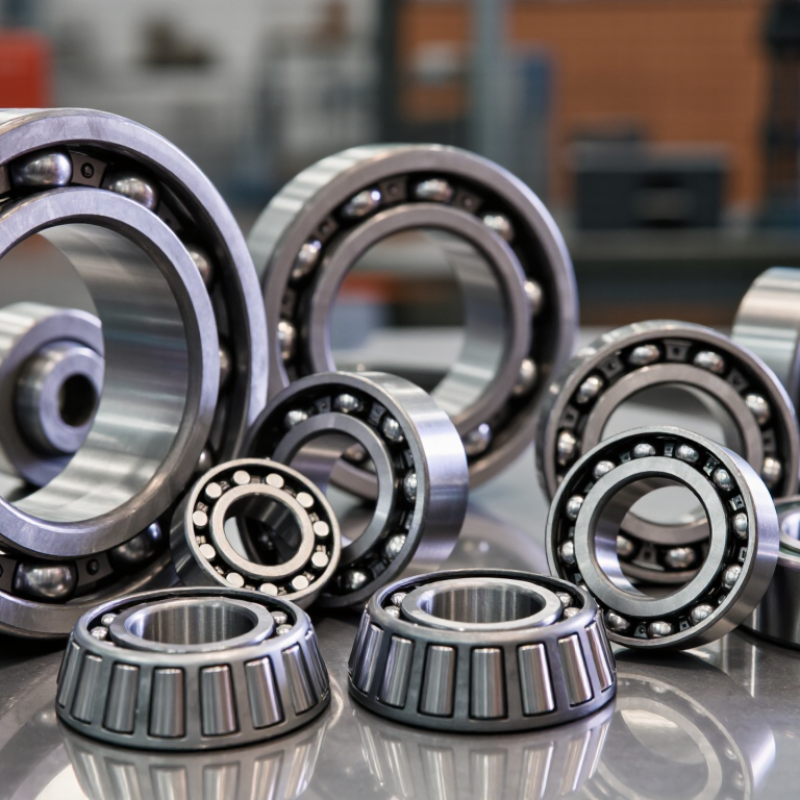
Industrial machinery uses axial bearings to control forces along a shaft, but operating conditions decide which design fits. A single-direction thrust ball bearing handles axial load from one side. Its double-direction counterpart supports load from both sides. Angular-contact thrust ball bearings suit applications needing accurate positioning and higher speeds. Compact and familiar.

For heavier loads, cylindrical roller thrust bearings offer high axial capacity but need careful alignment. Tapered roller thrust bearings combine axial and radial load support in suitable arrangements. Spherical roller thrust bearings can tolerate some shaft misalignment. Needle roller thrust bearings fit tight spaces, while needle thrust assemblies pair rollers and washers where space is especially limited. Each option has limits.

Hydrodynamic thrust bearings create a supporting oil film during motion. Hydrostatic designs use externally supplied pressure, including at low speeds or startup. These complete ten practical options. Check load direction, speed, temperature, lubrication, and available space before selection. For example, a dusty conveyor and a precision spindle may need very different solutions. Review mounting surfaces and maintenance access, too. A technically strong bearing can still disappoint if installation is poor. Selection is rarely neat; real machines often reveal constraints that drawings miss.

Comparing Bearing Types by Load, Speed, and Environment

Choosing an axial bearing means matching its load capacity, operating speed, and surroundings to the machine. Ball thrust bearings suit moderate axial loads and relatively high speeds, such as in compact pumps. For heavier loads, cylindrical roller thrust bearings spread force across a larger contact area, but usually need lower speeds and careful lubrication. Needle thrust bearings fit tight spaces; their thin profile leaves little room for misalignment.

There are trade-offs. Spherical roller thrust bearings can handle heavy loads and some shaft misalignment, making them useful in conveyors and processing equipment. Fluid-film thrust bearings support continuous, high-speed operation, provided the oil supply and startup conditions are controlled. Dust, moisture, and heat matter too. In a washdown area, corrosion resistance and effective sealing may matter more than a small speed advantage. In a dusty workshop, seals can help, but they cannot compensate for poor maintenance.

Check the load direction, peak speed, lubricant, and mounting alignment before comparing catalog ratings. A rating alone is not a guarantee. Real machinery vibrates, heats up, and sometimes runs outside ideal conditions. That part is easy to underestimate. Leave room for inspection and re-lubrication, and confirm the bearing’s limits against the actual duty cycle.

Installation and Maintenance for Reliable Bearing Performance

Axial bearings carry loads parallel to a shaft, so correct installation starts with confirming the load direction and bearing arrangement. Check the drawing and manufacturer’s instructions before opening the package. A clean bench, lint-free cloths, and covered parts help keep grit away from rolling surfaces. Cleanliness matters. Never drive a bearing into place through its rolling elements; use suitable fitting tools and apply force only to the ring being mounted. Check shaft and housing fits, shoulders, and mating faces for burrs or damage. A tiny raised edge can tilt the bearing and create uneven contact.

Use the specified lubricant and quantity, since excess grease can raise operating temperature. For oil systems, confirm the level and flow before startup. Tighten fasteners in the prescribed sequence, then rotate the shaft by hand to feel for binding or rough spots. Small details count. During the first run, monitor temperature, noise, vibration, and leakage; record readings rather than relying on memory. Recheck alignment and fastening after the system reaches operating conditions, where required by the equipment procedure. Maintenance intervals should reflect load, speed, contamination, and duty cycle, not just a calendar. In practice, schedules sometimes miss changing conditions, so adjust them when inspection trends point to wear or overheating.