

nbc logo (2)
Office address
National Engineering Industries Ltd.
Khatipura Road Jaipur – 302006 Rajasthan, India
Phone Number

Toll Free: 1800 3000 6222
Telephone: +91 141 222 3221
Fax: +91 141 222 1926, 222 2259
CIN: U29130WB1946PLC013643

Why Choose FPGA Chips for Your Next Project?

Choosing the right processor can shape a project’s speed, power use, and ability to adapt. A Fpga Chip offers a distinctive option: its logic can be configured to match a specific task rather than follow only a fixed instruction sequence. That makes it useful for parallel processing, precise timing, and custom interfaces. Consider a device reading several sensors at once. An FPGA can handle multiple signal paths concurrently, which may reduce delays between measurement and response.

The flexibility is real. So is the work. Engineers must plan the logic, verify timing, and test behavior across expected operating conditions. A design that looks simple on a block diagram can become harder when memory, clock limits, and power budgets enter the picture. Not magic. FPGA development tools also take time to learn, and some projects may run more efficiently on a microcontroller, CPU, or dedicated chip.

This article explores why teams choose FPGAs, where they fit, and what trade-offs deserve attention. It will look at practical strengths such as reconfigurability, parallelism, and predictable response times. It will also consider development effort, component cost, and the skills needed to maintain a design. A fair comparison starts with the project’s actual workload, not a technology trend. The right choice depends on measurable needs: data rates, latency limits, interface requirements, and expected production volume. A prototype can reveal surprises. That is useful, even when the answer is not FPGA.
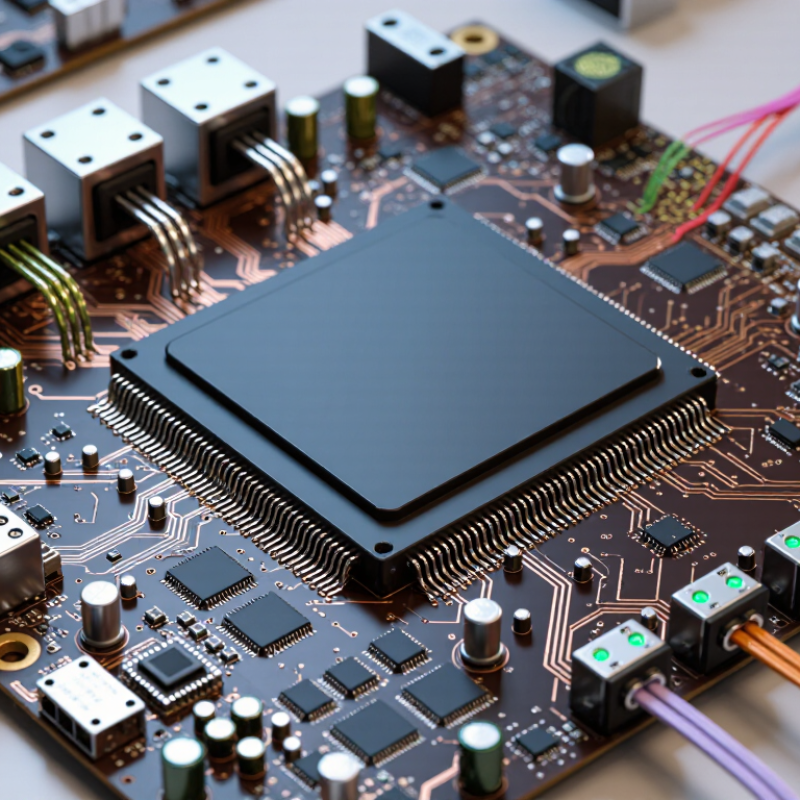
Why Choose FPGA Chips for Your Next Project?

What FPGA Chips Are and How They Work

An FPGA, or field-programmable gate array, is a chip whose internal logic can be configured after manufacturing. It contains configurable logic blocks, programmable connections, and input-output circuits. Some devices also include memory and digital signal processing blocks. Unlike a processor that follows a sequence of instructions, an FPGA can perform many operations in parallel. That is the key.

A designer describes the desired circuit using a hardware description language. Synthesis converts that description into logic elements, then placement and routing map them onto the chip. The result is a configuration bitstream that sets the logic and connections. Reconfiguration is possible, but timing and routing still demand careful testing. A blinking LED is simple; moving high-speed sensor data without glitches is not.

The market reflects growing interest in configurable computing. Fortune Business Insights estimated the global FPGA market at USD 9.92 billion in 2023, projecting USD 20.20 billion by 2032. That forecast signals opportunity, not guaranteed savings. FPGA development can take longer than expected, and a design that fits logically may still miss its timing target. It is easy to underestimate the work. A practical evaluation starts with the real workload, required latency, power limits, and the engineer-hours available for verification.

Key Advantages of FPGAs in Project Design

An FPGA can be reshaped to match a project’s processing needs. That makes it useful when standard processors cannot meet specific timing or interface requirements. Unlike a fixed processor, an FPGA can handle several operations in parallel. For example, it can process sensor data while managing a communication link. The workload runs concurrently. This can reduce delays in systems that need predictable response times, such as motor controllers or measurement equipment. Designers can also revise the logic after deployment, though updates still require careful testing.

Tips: Sketch the data path before choosing a device. Check I/O voltage, memory needs, clock rates, and thermal limits. Prototype one critical function, then measure timing and power on real hardware. Simulation alone may miss practical issues.

The trade-off is development effort. Hardware description languages require a different mindset from ordinary software, and timing closure can take repeated adjustments. Even a small design may need careful clock and resource planning. A practical review should compare FPGA development time with alternatives, not just compare processing speed. More logic is not automatically better. An FPGA is a stronger fit when parallelism, low latency, or custom interfaces matter enough to justify the added design and verification work.

How to Match an FPGA to Your Project Requirements

Choosing an FPGA begins with the work your project must perform, not the largest specification sheet. Describe the workload: image filtering, motor control, data capture, or custom communication logic. Then estimate how much parallel processing it needs and how quickly results must arrive. Benchmarks using representative data are more useful than broad performance claims. Small details matter.

Compare available logic resources, DSP blocks, and on-chip memory with your design’s estimated needs. Leave room for growth; a design that nearly fills the device can become difficult to update or route. Check I/O count, pin types, and voltage requirements against your board. A mismatch can force extra components or a board redesign. I/O planning is easy to overlook.

Power and heat also shape the choice. Estimate consumption under realistic workloads, then check whether your enclosure can dissipate that heat. Review development tools and documentation, too. A capable device may still be a poor fit if the team cannot verify timing or maintain the design. One estimate may be wrong, so prototype the most demanding function early. Test it on hardware, measure latency and power, and revise your assumptions before committing to a device.

Comparing FPGAs with CPUs, GPUs, and ASICs

An FPGA chip sits between a general-purpose processor and fixed-function hardware. A CPU runs flexible software, making it a practical choice for changing control logic or varied tasks. For example, a CPU can inspect sensor readings and adjust a control loop without rebuilding the hardware. That is convenient. But tight timing requirements can make software scheduling difficult.

A GPU handles many similar calculations in parallel, such as image filters or matrix operations. It often suits workloads with large batches of data, though moving data to and from the device can add delay. An FPGA can instead process a stream as it arrives. A camera pipeline, for instance, might correct pixels and detect edges in a predictable sequence. That low-latency path takes careful design. It is not automatic.

An ASIC can deliver excellent performance and energy efficiency once its function is stable. Yet a late design change may require costly hardware revisions. An FPGA can be reconfigured, which helps when protocols or algorithms are still evolving. The trade-off is development effort: engineers must manage timing, resource limits, and verification. A bench test can mislead. Measure real workloads, including power and data-transfer costs, before choosing. It is easy to overvalue flexibility; sometimes a CPU is simply easier to maintain.

Common FPGA Applications and Design Considerations

FPGAs are useful when a project needs parallel processing, predictable response times, or changing interfaces. Common applications include industrial vision, communications equipment, medical imaging, and automotive prototyping. The International Energy Agency’s Global EV Outlook 2024 reports nearly 14 million electric cars sold worldwide in 2023, about 18% of total car sales. This growth increases demand for adaptable vehicle electronics, though an FPGA is not automatically the right choice for every control task.

Design decisions begin with the workload. Estimate logic use, memory, data rates, and latency before choosing a device. Then check whether its I/O standards match the sensors and converters on your board. A camera stream may need parallel image operations, while a motor-control loop may depend on tight timing. Power and heat matter too: a compact enclosure can turn a manageable design into a thermal problem. Timing still bites. Leave room for testing and revisions; early estimates are often optimistic.

Tips: Prototype the most timing-sensitive function first. Measure power under realistic workloads, not just in simulation. Keep a simpler fallback architecture in mind, especially when the team has limited hardware-debugging experience.

Why Choose FPGA Chips for Your Next Project? Common Applications and Design Considerations

Application Why an FPGA May Be a Good Fit Typical Workload Key Design Considerations When to Consider Another Approach
Digital signal processing Parallel logic can process multiple data samples or channels concurrently, and the hardware pipeline can be tailored to the algorithm. Filtering, fast Fourier transforms, channelization, and custom signal pipelines. Estimate multiplier and memory use; define fixed-point precision; validate latency, throughput, and numerical error. A CPU or DSP may be simpler for low-throughput tasks or algorithms that change frequently.
Networking and packet processing Custom datapaths can handle multiple processing stages with predictable latency and support interfaces that may not be available in a standard processor. Packet classification, header parsing, traffic shaping, and protocol adaptation. Account for line rate, buffering, clock-domain crossings, protocol edge cases, and timing closure. A network processor or software solution may be preferable when standard protocols and flexible updates matter more than custom datapaths.
Industrial control and data acquisition Dedicated logic can coordinate parallel I/O, counters, encoders, and control functions with consistent timing. Motor-control interfaces, sensor capture, encoder processing, and custom real-time I/O. Plan for deterministic response, electrical interfaces, isolation, fault handling, and system-level safety requirements. A microcontroller or PLC may be more practical for modest I/O counts and conventional control sequences.
Image and video processing Streaming pipelines can operate on successive pixels or image regions in parallel, reducing the need to process every step sequentially. Color conversion, image filtering, feature extraction, and video-format conversion. Consider pixel rate, line buffers, memory bandwidth, input/output formats, and end-to-end latency. A GPU or dedicated image processor may offer a better development path for highly programmable, large-scale image workloads.
Hardware prototyping and interface bridging Reconfigurable logic makes it possible to test custom hardware behavior and connect systems with different timing or interface requirements. Digital prototypes, bus bridging, custom peripherals, and pre-silicon verification platforms. Keep the prototype architecture aligned with the intended production design and account for differences in timing and physical interfaces. A software model may be faster for early functional exploration when real-time I/O and hardware-level timing are not required.
Aerospace and embedded systems Some FPGA devices support designs that require custom logic, predictable operation, or integration of multiple functions in one programmable device. Control logic, data handling, instrumentation, and specialized embedded interfaces. Assess qualification needs, environmental conditions, configuration management, fault tolerance, and verification effort. A standard processor can be a better choice when the workload is mainly sequential and a suitable certified platform is available.

Note: FPGA performance, power use, cost, and development effort depend on the selected device, implementation, interfaces, and project requirements. Validate these factors with a representative design.