

Toll Free: 1800 3000 6222
Telephone: +91 141 222 3221
Fax: +91 141 222 1926, 222 2259
CIN: U29130WB1946PLC013643
Founded in 1946, National Engineering Industries Ltd (NEI) is India’s leading bearings manufacturer and exporter, renowned for excellence in quality and delivery.

A Heat Pump Water Tank can heat household water while using less electricity than a conventional electric-resistance unit. Instead of generating heat directly, it moves warmth from surrounding air into stored water. The U.S. Department of Energy’s Energy Saver guidance says heat pump water heaters can be two to three times more energy-efficient than standard electric models. That difference can matter in homes where showers, laundry, and dishwashing all draw from the same tank.
The technology is practical, but it is not magic. A typical unit needs room for airflow, a suitable installation space, and a plan for draining condensate. In a small utility closet, its fan may also be noticeable. Because the unit pulls heat from nearby air, a cold or poorly ventilated location can affect performance. These details deserve attention before comparing purchase prices. A lower energy bill is useful; a unit that does not fit the home is not.
This article explores why homeowners consider a heat pump water tank, what efficiency claims mean, and which installation details can shape real-world results. The Department of Energy’s figures offer a helpful benchmark, not a guarantee for every household. Usage patterns, local electricity rates, climate, and settings all influence savings. The honest answer is that the best choice depends on the home. A quick check of space, airflow, and hot-water demand can prevent an expensive mismatch.
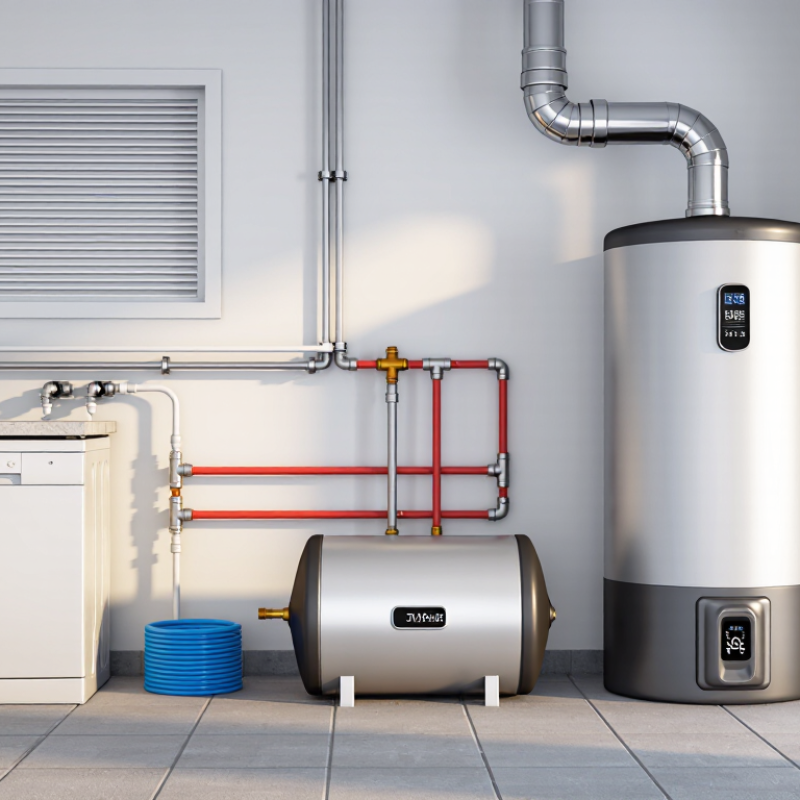
A heat pump water tank stores hot water while using heat from surrounding air to warm it. Unlike a conventional electric-resistance unit, it moves heat rather than creating it directly. The U.S. Department of Energy’s Energy Saver guidance says heat pump water heaters can be two to three times more energy-efficient than standard electric-resistance models. That difference depends on operating conditions. The room still matters.
Inside the unit, a fan draws air across an evaporator coil, where refrigerant absorbs heat. A compressor raises the refrigerant’s pressure and temperature. The condenser then transfers that heat to the stored water, while an expansion device resets the refrigerant for another cycle. The insulated tank limits heat loss; sensors and controls regulate water temperature. Many models also include electric-resistance elements for periods of high demand or colder conditions.
In a utility room, the fan’s airflow and operating sound are practical details, not mere specifications. The unit also needs suitable air space and drainage for condensate. Those needs can complicate a tight installation. The tank’s controls may offer efficiency or high-demand settings, but settings and performance vary by model. A heat pump tank is not simply a better-insulated cylinder; it is a storage vessel paired with a refrigeration system, and both sides need attention.

Why Choose a Heat Pump Water Tank?
A heat pump water tank moves heat rather than creating it with an electric resistance element. A fan draws room air across an evaporator coil, where refrigerant absorbs heat and changes into vapor. The compressor then raises the refrigerant’s pressure and temperature. At the condenser, that heat passes into the stored water. The refrigerant cools, expands, and returns to the evaporator. A cycle repeats. It is a compact process, but the compressor and airflow still need room to work.
The U.S. Department of Energy says heat pump water heaters can be two to three times more energy-efficient than conventional electric resistance models. That advantage depends on operating conditions, including surrounding air temperature and hot-water demand. One trade-off is easy to overlook: drawing heat from indoor air can cool the space. On a cold day, that effect may matter in a small utility room. The tank also needs time to recover after heavy use.
Tips: Keep the air intake and exhaust clear, and check the installation manual’s room-volume requirements. Track your household’s hot-water use for a week before choosing tank capacity. Small detail. A tank that is too small may leave showers competing for heat.
How the refrigerant cycle transfers heat into stored water
At this illustrative operating point, 1 kWh of electricity powers the compressor and fan while the refrigerant cycle collects about 2 kWh of heat from the surrounding air. The combined 3 kWh is delivered to the water (COP 3.0). Actual performance varies with air temperature, water temperature, and system conditions.
Why Choose a Heat Pump Water Tank?
The DOE efficiency benchmark gives heat pump water heaters a clear advantage: they can be two to three times more efficient than electric resistance models. Instead of creating heat directly, they move heat from surrounding air into the tank. That difference can reduce the electricity needed to heat the same amount of water. In practice, actual savings depend on the unit, household hot-water use, and installation conditions. The benchmark is a useful comparison, not a promise about every monthly bill.
The benefit comes with a few practical details. A heat pump model needs enough surrounding air and clearance to operate properly. Its fan may be audible, and the unit can cool the space around it. A basement or utility room with suitable airflow may work well; a cramped closet may not. Check the product’s efficiency rating, tank size, and installation guidance before choosing. Also consider recovery time after several showers in a row. That part can be easy to overlook. Comparing your current electricity use with expected usage can help set realistic expectations, though estimates are never perfect.
| Comparison Dimension | Heat Pump Water Heater (HPWH) | Electric Resistance Water Heater |
|---|---|---|
| How it heats water | Uses electricity to move heat from the surrounding air into the water; many models also include electric resistance elements for backup or higher-demand operation. | Uses electric resistance elements to convert electricity directly into heat in the water. |
| Energy efficiency | DOE guidance says heat pump water heaters can be 2–3 times more energy-efficient than conventional electric resistance models. Actual performance depends on the model, installation, and operating conditions. | Serves as the comparison baseline for the DOE 2–3× efficiency benchmark. |
| Illustrative electricity use for the same hot-water output | At a 2–3× efficiency ratio, roughly one-half to one-third as much electricity as resistance heating. This is an illustration of the efficiency ratio, not a guaranteed household result. | Reference level: 100% of the electricity use in this illustrative comparison. |
| Potential household benefit | May reduce electricity used for water heating compared with conventional electric resistance, especially when the unit operates in heat-pump mode. | Does not transfer heat from the surrounding air, so it generally uses more electricity than an HPWH for the same water-heating output. |
| Installation considerations | Needs a suitable location with enough surrounding air and clearance for airflow. The installation space can become cooler as the unit draws heat from the air. | Typically has fewer airflow and room-temperature considerations because it heats water directly with resistance elements. |
| Performance considerations | Efficiency and recovery can vary with surrounding air temperature, hot-water demand, settings, and whether resistance backup is used. | Heating performance is not dependent on extracting heat from surrounding air, though electricity use depends on hot-water demand and the unit’s characteristics. |
Source: U.S. Department of Energy, Heat Pump Water Heaters. The efficiency comparison is a general benchmark; actual results vary by product, installation, climate, and household hot-water use.
A heat pump water tank needs room to draw and move air. The U.S. Department of Energy’s Energy Saver guidance recommends at least 1,000 cubic feet of surrounding air, unless the unit is ducted. That is roughly a 10-by-10-by-10-foot space. A cramped closet can restrict airflow, while the unit’s cool exhaust may make a small room noticeably colder.
Not just a closet. Check the installation manual for clearance and ducting options before choosing a location.
Drainage matters, too. Heat pumps produce condensate, so the tank needs a suitable drain or condensate pump. Plan the route before installation; a long, awkward drain line can become a maintenance headache.
DOE guidance also recommends a location that stays between 40°F and 90°F year-round. Colder conditions can reduce efficiency or prompt more backup heating, but exact operating limits vary by model. I would not treat the 1,000-cubic-foot figure as a universal room rule: duct design and site conditions matter. A qualified installer can check airflow, drain slope, and ambient temperatures at the actual location.
A heat pump water tank moves heat from surrounding air into stored water instead of making heat directly with electric resistance. ENERGY STAR’s heat pump water heater guidance reports up to 70% less energy use than standard electric models. “Up to” matters: actual savings depend on hot-water habits, climate, and installation. Not every home will hit the benchmark.
The U.S. Department of Energy’s Energy Saver guidance describes heat pump water heaters as two to three times more energy-efficient than conventional electric resistance units. In practice, that efficiency can mean fewer kilowatt-hours for morning showers, laundry, and dishwashing. Check the tank’s Uniform Energy Factor and estimated annual energy use on its EnergyGuide label; compare like-sized models, not just purchase prices. The figures are useful, but household results can be messier.
Location matters. A unit needs suitable air temperature and clearance, and its fan can be audible in a quiet utility room. It may also cool and dehumidify the surrounding space, which can help in a warm basement but feel less welcome in a chilly one. ENERGY STAR and DOE figures describe performance under specified conditions, not a promise for every home. Measure the space, consider local climate, and ask an installer to assess airflow and hot-water demand. Small details count.
Copyright © 2023 NEI Ltd. All rights reserved.
Registered Office : 9/1, R. N. Mukherjee Road, Kolkata – 700 001. In case of any queries or grievances, please contact Mr.Tarun Kumar Kabra, Company Secretary.
E-mail: sale@kinpart.com Privacy Policy Cookie Policy