

nbc logo (2)
Office address
National Engineering Industries Ltd.
Khatipura Road Jaipur – 302006 Rajasthan, India
Phone Number

Toll Free: 1800 3000 6222
Telephone: +91 141 222 3221
Fax: +91 141 222 1926, 222 2259
CIN: U29130WB1946PLC013643

Top 10 Track Chain Link Manufacturers for Global Buyers

Choosing the right Track Chain Link manufacturer is not just a price exercise. Undercarriage chains operate under repeated impact, abrasive soil, heavy loads, and changing temperatures. A link that looks correct on a drawing may still perform poorly if its dimensions, steel grade, or heat treatment do not match the machine and working conditions.

This guide introduces ten manufacturers for global buyers to investigate, not as a universal ranking or endorsement. It highlights practical comparison points: product range, manufacturing experience, quality-control processes, customization options, export support, and communication. Buyers should confirm key specifications, including pitch, link width, pin and bushing details, and compatibility with the machine model. Ask for inspection records or test information where available, and clarify packaging, lead times, and replacement-part support before placing an order. Small details matter.

Supplier information can change, and a polished catalog does not prove consistent field performance. That is worth remembering. Request current documentation, compare quotations on the same technical basis, and discuss the machine’s actual operating conditions with each shortlisted company. If possible, review samples or speak with existing customers. Even then, no checklist removes every risk; wear life depends on maintenance, terrain, load, and operator practice as well as component quality. The manufacturers featured here provide a starting point for careful research, helping procurement teams ask clearer questions and make a more informed choice for their fleets.
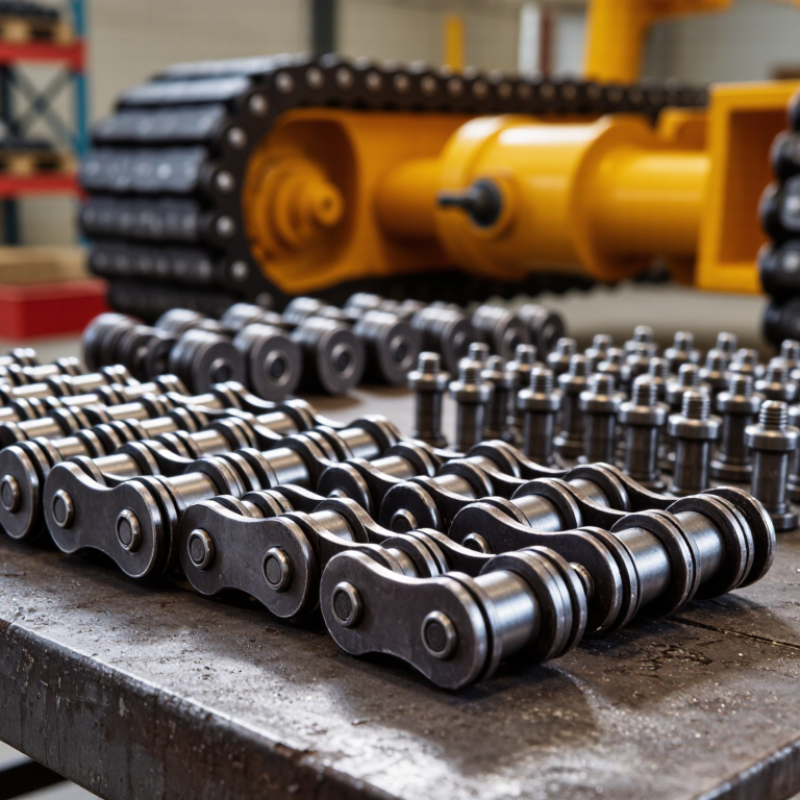
Top 10 Track Chain Link Manufacturers for Global Buyers

Track Chain Links Defined: Pitch, Link Count, Pin Diameter, and Bushing Size

Top 10 Track Chain Link Manufacturers for Global Buyers

Track Chain Links Defined: Pitch, Link Count, Pin Diameter, and Bushing Size

Track chain fit depends on several measurements working together. Pitch is the distance between the centers of adjacent pins. Measure across multiple links, then divide by the number of intervals to reduce small measuring errors. A few millimeters can affect sprocket engagement and wear.

Link count means the number of complete links in the chain assembly. Count carefully; do not estimate from a short visible section. Pin diameter and bushing size also matter. The pin joins the links, while the bushing surrounds it and contacts the sprocket. Worn parts can give misleading readings. A caliper helps, but measurements alone may not confirm compatibility. Compare them with the machine’s parts specification and account for the undercarriage configuration.

Tips: Clean away packed dirt before measuring. Measure pins and bushings at several points, since wear may be uneven. Keep the old chain’s link count for reference, but verify it against the machine specification. Measure twice. A tidy chart cannot replace inspection, and that is easy to overlook.
Industry Standards: ISO 9001:2015 Quality Systems and OEM Compatibility Data

For global buyers comparing track chain link manufacturers, ISO 9001:2015 certification is a useful starting point, not a product guarantee. The standard requires controlled processes, documented responsibilities, and corrective action when defects occur. ISO’s Survey 2022 recorded 1,265,216 valid ISO 9001 certificates worldwide. That scale shows how widely the system is used; it does not prove every factory applies it equally.

Ask for the certificate’s scope, issuing body, and latest audit date. Then request inspection records tied to a production batch. Useful checks include link pitch, bushing bore, pin fit, hardness readings, and dimensional tolerances. A supplier should explain how measurements are taken, not just send a polished table. Small differences matter. A chain that looks right may still run unevenly on an existing undercarriage.

OEM compatibility data should identify the machine model and part reference, plus any confirmed interchange details. ISO 9001:2015 supports controlled purchasing and production records, but it does not set universal track-chain dimensions. Request material certificates, heat-treatment results, and a sample inspection report before approving volume orders. One caution: supplier data can be incomplete, and buyers sometimes accept it too quickly. Verify critical dimensions against the removed link or original technical drawing. Sources: ISO 9001:2015; ISO Survey 2022.

ISO 9001:2015 Quality Systems and OEM Compatibility

High-level numbered subclauses across the seven main ISO 9001:2015 requirement clauses

Counts represent the numbered subclauses beneath clauses 4–10 (for example, 8.1–8.7); they are not weighted measures of importance. ISO 9001 certification indicates a quality management system, but does not by itself confirm track-chain fitment or OEM compatibility. Buyers should verify dimensions, interface specifications, materials, and application requirements against product-specific documentation.

Manufacturer Comparison Metrics: Steel Grade, HRC Hardness, and Fatigue Life

When comparing track chain link manufacturers, start with the steel grade, not a headline hardness number. SAE J403 defines chemical composition ranges for carbon steels, while alloy-steel grades may be specified through other standards. Ask for the actual grade, heat-treatment record, and test certificate. A grade name alone does not prove consistent chemistry or performance.

Hardness should be measured using a recognized method. ASTM E18 specifies Rockwell hardness testing, including HRC; however, a higher HRC reading is not automatically better. Excessive hardness can reduce toughness, especially around pin bores and corners where stress concentrates. Request readings from several locations, not just a polished surface. Small details matter.

Fatigue life needs equally careful scrutiny. ASTM E466 describes axial fatigue testing, but it does not set one universal pass number for track links. Ask suppliers to disclose load, cycle count, sample quantity, and failure criteria. Results from a controlled laboratory test may not match abrasive soil, impact, or poor lubrication in service. That gap is easy to overlook.

Tips: Compare like with like. Put steel grade, HRC range, and fatigue-test conditions in one table. If a report omits test conditions, treat its cycle figure cautiously. A few clear records beat a glossy claim.

Top 10 Track Chain Link Manufacturers: Product Range, Regions, and Applications

A comparison of ten track chain link manufacturers should look beyond catalog size. Product ranges may include standard links, reinforced links, master links, and matched assemblies for different undercarriage designs. Buyers should confirm dimensions, material specifications, heat-treatment details, and compatibility with the machine’s make and operating weight. Small differences matter.

Manufacturing regions influence lead times, shipping costs, and access to replacement stock. Suppliers serving North America, Europe, and Asia may offer different production capacities and regional distribution networks. Ask where components are made and inspected, not only where an office is located. Clear traceability helps maintenance teams match replacement links to existing chains. Paperwork is useful, but fit still needs checking.

Applications vary from compact excavators on tight urban sites to large dozers working in abrasive mines. Softer ground may call for broader contact surfaces, while rocky terrain places greater stress on link wear and joint strength. Request application guidance based on ground conditions, machine model, and expected operating hours. A published service-life estimate is not a guarantee. Field conditions are messy, and comparisons between suppliers can be imperfect. A practical shortlist weighs product coverage, regional support, documented quality controls, and the ease of obtaining technical answers.

Buyer Evaluation: Wear Limits, Warranty Terms, Lead Times, and Total Cost of Ownership

For global buyers comparing track chain link manufacturers, wear limits should be tied to actual working conditions. Ask how elongation is measured and what inspection method supports the stated limit. A chain used in abrasive soil may wear faster than one operating on firm ground. Request sample inspection records, not just a durability claim. Small details matter.

Warranty terms need equal scrutiny. Check which parts are covered, when the warranty begins, and whether labor or freight is excluded. Ask what evidence is required for a claim, such as installation records or wear measurements. A long warranty can look reassuring, but narrow exclusions may reduce its practical value. Read the fine print.

Lead times should include production, inspection, packing, and transit—not only factory completion. Confirm whether quoted dates apply to stocked parts or a new production run. For total cost of ownership, compare purchase price with expected service life, replacement labor, freight, and downtime. A lower quote may cost more if the machine sits idle. That happens.

A simple comparison sheet helps, but it can miss changing ground conditions and seasonal demand. I would record assumptions beside each estimate and revisit them after the first inspection. Buyers rarely know every variable in advance; transparent answers and consistent documentation are more useful than confident promises.

Top 10 Track Chain Link Manufacturers for Global Buyers - Buyer Evaluation: Wear Limits, Warranty Terms, Lead Times, and Total Cost of Ownership

Data note: No supplier-specific specifications, warranty documents, or quotations were provided. To avoid presenting unverified claims as facts, the anonymous entries below are comparison slots rather than a verified ranking. Wear limits, warranty coverage, lead times, and costs should be confirmed directly with each supplier in writing.

Evaluation Slot Track Chain Wear Limit Warranty Terms Quoted Lead Time Total Cost of Ownership (TCO) Buyer Verification Checklist
Supplier 1 Not provided; request the allowable pitch elongation and inspection method for the specific chain part number. Not provided; obtain written coverage, exclusions, claim process, and start date. Quote required; confirm production time separately from transit and customs time. Calculate from purchase price, freight, installation, maintenance, downtime, and replacement frequency. Request drawings, material and heat-treatment specifications, inspection records, and a dated quotation.
Supplier 2 Not provided; verify whether the limit applies to chain pitch, pin-and-bushing wear, or another measurement. Not provided; clarify whether parts, labor, freight, and consequential losses are included or excluded. Quote required; ask for available stock, minimum order quantity, and dispatch date. Compare delivered cost and expected service life under the same machine and operating conditions. Confirm machine compatibility, part-number interchange, packaging, and country-of-origin documents.
Supplier 3 Not provided; request new-part dimensions and the stated service or replacement threshold. Not provided; check warranty duration, operating-hour limits, and required maintenance records. Quote required; request lead time for both standard and urgent orders. Include inspection labor, downtime exposure, spare-parts inventory, and end-of-life replacement cost. Request quality-control procedures, dimensional inspection results, and sample traceability records.
Supplier 4 Not provided; ask for the measurement points, tool requirements, and inspection interval. Not provided; confirm whether wear under normal service is covered and how defects are assessed. Quote required; confirm the Incoterm, shipping mode, and estimated arrival date. Use a consistent ownership period and operating-hours assumption when comparing offers. Check payment terms, export packaging, shipping documents, and after-sales response arrangements.
Supplier 5 Not provided; request application-specific limits for the intended load, terrain, and duty cycle. Not provided; obtain the complete written warranty rather than relying on a summary statement. Quote required; distinguish confirmed production capacity from an estimated schedule. Account for lubrication and maintenance requirements, replacement labor, and supply interruptions. Request application references, installation guidance, and documented product inspection criteria.
Supplier 6 Not provided; verify the acceptance criteria for incoming inspection and in-service monitoring. Not provided; confirm the evidence required to submit a claim and the remedy offered if approved. Quote required; ask whether the schedule changes with order quantity or customization. Compare cost per operating hour where reliable service-life and operating data are available. Verify production location, inspection documentation, spare-part availability, and order-change terms.
Supplier 7 Not provided; request wear limits for the complete assembly and for separately replaceable components. Not provided; check geographic coverage, authorized service channels, and claim-response expectations. Quote required; confirm whether the estimate includes inspection, production, and export handling. Include duties, taxes, local handling, maintenance, and disposal or recycling costs where applicable. Confirm local support, technical documentation, labeling, and compliance requirements for the destination market.
Supplier 8 Not provided; ask how lubrication, contamination, alignment, and operating conditions affect the stated limit. Not provided; verify whether installation by an approved technician is a condition of coverage. Quote required; request a written schedule with milestones and delay-notification terms. Model expected replacements and downtime using the buyer’s actual usage and maintenance history. Request installation instructions, recommended inspection practices, and evidence supporting service-life claims.
Supplier 9 Not provided; request tolerances and the procedure for resolving out-of-specification measurements. Not provided; clarify the process for inspection, return authorization, repair, or replacement. Quote required; confirm the shipping origin and the party responsible for freight and import clearance. Assess price alongside expected life, delivery reliability, warranty recovery, and support costs. Check quotation validity, currency, payment security, dispute terms, and document retention.
Supplier 10 Not provided; agree on measurable acceptance criteria before purchase and retain baseline measurements. Not provided; record the governing warranty document and any negotiated exceptions in the contract. Quote required; validate the promised date against the purchase order and shipment tracking plan. Use a documented comparison: acquisition + logistics + maintenance + downtime + replacement − residual value. Complete a technical review, reference check, sample evaluation, and commercial risk assessment before ranking.

Recommended comparison basis: Use the same machine model, operating conditions, evaluation period, currency, delivery terms, and service-life assumptions for every quotation. Do not treat a stated wear limit as universal; confirm its definition and measurement procedure for the specific track chain assembly.