

Toll Free: 1800 3000 6222
Telephone: +91 141 222 3221
Fax: +91 141 222 1926, 222 2259
CIN: U29130WB1946PLC013643
Founded in 1946, National Engineering Industries Ltd (NEI) is India’s leading bearings manufacturer and exporter, renowned for excellence in quality and delivery.

A Vtol Fixed Wing Drone can take off from a compact clearing, transition into efficient forward flight, and cover ground that would quickly drain a multirotor battery. For buyers, that blend is compelling—but the specification sheet is only the beginning. Endurance depends on payload, wind, launch conditions, and flight profile. A quoted range is not a mission guarantee.
The FAA’s Aerospace Forecast FY 2023–2043 projected the U.S. commercial small-UAS fleet would grow from 412,000 aircraft in 2022 to 955,000 by 2027. That forecast describes the wider market, not VTOL fixed-wing sales, but it signals why buyers should compare support, training, and data workflows alongside airframes. Range matters. Payload matters. Details count.
FAA Administrator Mike Whitaker’s safety maxim, “Safety is our North Star,” is a useful standard for evaluating any shortlist. For this guide, the practical questions are specific: Can the aircraft carry the required sensor? How much runway-free space does it need? What happens when wind rises or a battery ages? Compare the top 10 options by mission fit, endurance, payload, launch and landing flexibility, maintenance, and service access. Manufacturer figures deserve scrutiny; test conditions can differ from field conditions. No ranking can replace a demonstration flight. And no single model suits every team. These comparisons aim to make trade-offs visible, while recognizing that a polished specification table can still leave important questions unanswered.
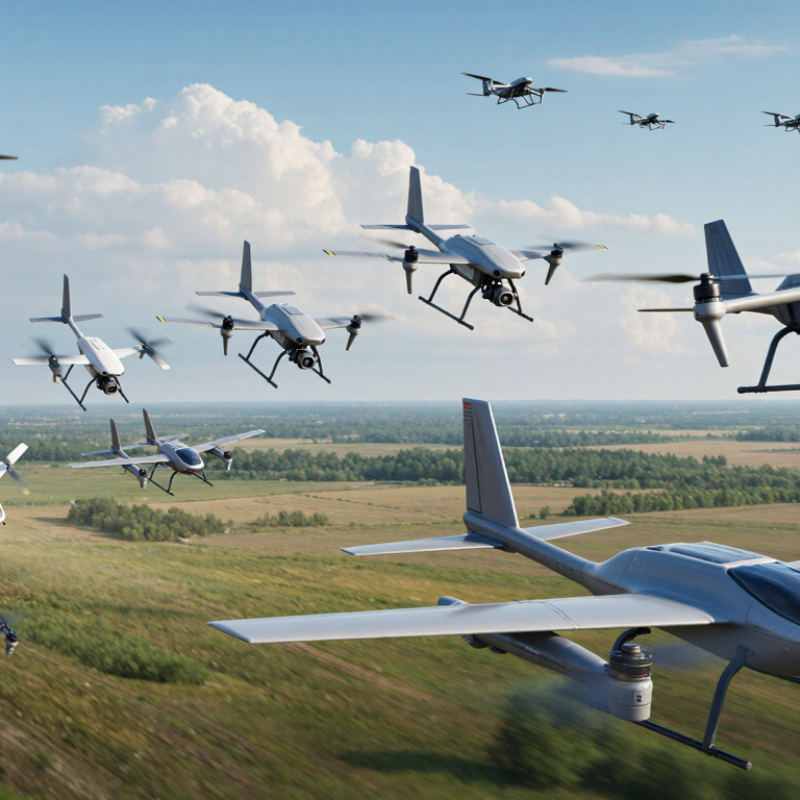
A vertical takeoff and landing (VTOL) fixed-wing drone combines two flight modes. It rises and lands vertically using lift rotors, then transitions to forward flight, where its wings provide lift. No runway is needed. In practical terms, a crew can launch from a small clearing, watch the aircraft climb above nearby trees, and send it along a planned survey route. Compared with a multirotor, the wing can support longer-distance flight; compared with a conventional fixed-wing aircraft, VTOL reduces launch and recovery space. The trade-off is added mechanical and control complexity.
The transition is the awkward part. During conversion from hovering to forward flight, the aircraft must build airspeed while maintaining stable lift. Payload weight, wind, battery condition, and transition settings can all affect performance. Buyers should check usable flight time with the intended sensor fitted, not rely only on an empty-aircraft maximum.
Drone Industry Insights’ Drone Market Report 2024 projected the overall drone market would grow from about $30.6 billion in 2022 to $54.6 billion by 2030; that figure covers the broader market, not VTOL aircraft alone. The FAA’s Aerospace Forecast also tracks continued growth in commercial small-drone operations, adding context for demand but not proving any one aircraft’s suitability.
Details matter. A claimed long range means little if the mission requires frequent hovering, heavy cameras, or cautious landings in gusty conditions.

VTOL fixed-wing drones combine vertical takeoff with efficient forward flight, but the change between modes is the critical part. At launch, vertical rotors lift the aircraft from a small pad, much like a steady elevator. Once clear of nearby obstacles, the aircraft pitches forward and gains airspeed. The flight controller adjusts thrust and attitude while the wing begins carrying more weight. Lift motors may slow or stop, depending on the design. The handoff should feel uneventful.
For buyers comparing ten designs, examine the transition sequence, not just advertised range. Ask whether the aircraft pauses to build speed, how it handles gusts, and what happens if airspeed rises slowly. A practical test includes a loaded flight, because cameras or sensors can change balance and response. Watch the nose, listen for abrupt motor changes, and check whether altitude remains steady. These observations are more useful than a polished animation. Transition performance depends on wing loading, control tuning, and weather; one clean demo proves little. There is room for doubt. This design detail deserves attention before purchase.
For a VTOL fixed-wing drone, compare useful payload before headline endurance. Record payload mass, mounting position, and power draw; a camera that fits on the rail may still reduce flight time. Check the stated endurance against a defined payload, wind speed, and reserve. A bare-airframe test is not a mission plan. Small details matter.
Compare cruise speed, stall speed, operating range, and transition time between vertical lift and forward flight. Ask whether range means one-way distance or total flight distance. Battery capacity alone is not enough: request usable energy and charging time, then check performance in cold or hot conditions.
A 2024–2030 market forecast from Drone Industry Insights estimates the global drone market could reach $54.6 billion by 2030. That is market context, not proof that any aircraft meets a buyer’s needs.
For mapping or inspection, compare navigation accuracy, camera or sensor compatibility, data-link range, and lost-link behavior. Review wind limits and landing requirements too; a narrow clearing can change the real mission envelope. Ask for test conditions and repeatable flight logs, not only brochure figures. Even then, field results vary. It is easy to overvalue a long range figure when terrain, payload, and reserve margins are treated separately.
VTOL fixed-wing drones combine vertical takeoff with efficient forward flight, but their capabilities vary sharply. The FAA’s 2024 Aerospace Forecast estimates the U.S. commercial small-drone fleet could grow from about 855,000 aircraft in 2023 to 1.18 million by 2028. That growth makes careful capability comparisons more useful than headline range claims.
For buyers comparing ten core capability profiles, examine transition stability and endurance for long surveys. Check payload capacity and mapping accuracy for detailed inspections. Corridor-monitoring aircraft need reliable navigation along roads or pipelines. Agricultural platforms benefit from multispectral sensors and repeatable flight paths. Search aircraft need thermal imaging and rapid deployment. Coastal units need corrosion-resistant components. Cargo configurations need secure, balanced payload bays. Compact airframes suit constrained launch sites. Weather-tolerant designs need robust links and clear operating limits. Small details matter.
A published endurance figure rarely reflects wind, cold batteries, sensor weight, or repeated vertical climbs. One trade-off is easy to understate. A larger wing may extend coverage, yet make transport and setup awkward. Buyers should compare flight logs, payload-tested endurance, landing accuracy, and maintenance records, not just manufacturer specifications. Ask for the conditions behind each number.
An attractive chart is not field evidence.
Choosing among the top 10 VTOL fixed-wing drones starts with the mission, not the advertised range. For a 12-kilometer pipeline inspection, prioritize stable mapping, useful camera payload, and enough reserve for wind and return flight. For crop surveys, compare ground coverage per battery, image consistency, and how quickly the aircraft can be prepared between fields. A vertical takeoff helps where launch space is limited, but the transition to forward flight adds another system to assess.
Payload and endurance claims need context. Ask whether the quoted flight time includes a working sensor, realistic wind, and a safe landing reserve. The FAA’s 2024–2044 Aerospace Forecast estimates the U.S. commercial small-drone fleet could grow from about 412,000 aircraft in 2023 to 966,000 by 2028. That projection signals a crowded operating environment, not a reason to buy the longest-range model. Check service access, operator training, data workflow, and performance in the temperatures you actually face. I would not treat a specification sheet as a field test.
Tips: List your mission radius, payload weight, launch conditions, and daily flight count before comparing models. Request a representative flight demonstration. Record setup time and usable coverage, too. Those details are easy to overlook.
| Configuration | Typical Endurance | Typical Payload | Best-Fit Missions | Key Buyer Considerations |
|---|---|---|---|---|
| 1. Compact hand-portable mapper | About 45–90 minutes | About 0.2–1 kg | Small-site mapping, construction progress, and rapid local surveys | Prioritize quick setup, transportability, and simple field servicing; shorter flights may require more battery changes. |
| 2. Portable survey aircraft | About 1.5–3 hours | About 0.5–2 kg | Land surveying, orthomosaic production, and medium-sized worksites | Check camera compatibility, ground-control workflow, wind limits, and the time needed to assemble the aircraft. |
| 3. Long-endurance area mapper | About 3–6 hours | About 0.5–3 kg | Large-area mapping, land management, and environmental monitoring | Evaluate battery or fuel logistics, data storage, launch-site access, and the permissions required for extended operations. |
| 4. Corridor inspection configuration | About 2–5 hours | About 0.5–2.5 kg | Road, rail, pipeline, and power-line surveys | Assess route-planning tools, image overlap, communications coverage, and procedures for operating near infrastructure. |
| 5. Multispectral agriculture configuration | About 1–3 hours | About 0.3–1.5 kg | Crop scouting, vegetation assessment, and field mapping | Confirm sensor calibration, lighting workflow, field-level processing needs, and compatibility with the intended analysis software. |
| 6. Thermal inspection configuration | About 1.5–4 hours | About 0.5–2 kg | Thermal surveys, roof and asset inspections, and habitat monitoring | Compare thermal resolution and radiometric requirements; account for temperature, weather, and image-interpretation needs. |
| 7. Heavy-payload utility configuration | About 1–3 hours | About 2–8 kg | Larger sensor packages and specialized inspection equipment | Payload reduces endurance; verify center-of-gravity limits, mounting options, takeoff weight, and landing-site requirements. |
| 8. Rugged field-deployment configuration | About 1.5–4 hours | About 0.5–3 kg | Remote-area surveys and work from austere or uneven sites | Look for field-replaceable parts, weather protection, practical packing dimensions, and a recovery method suited to the site. |
| 9. Coastal and maritime survey configuration | About 2–5 hours | About 0.5–2.5 kg | Shoreline mapping, coastal monitoring, and vessel-area observation | Salt exposure and wind can affect operations; check corrosion protection, recovery options, and local airspace and maritime rules. |
| 10. Long-range communications configuration | About 3–8 hours | About 0.5–3 kg | Extended-area observation and operations requiring a communications relay | Confirm link budget, antenna placement, lost-link behavior, spectrum authorization, and whether beyond-visual-line-of-sight approval is available. |
Copyright © 2023 NEI Ltd. All rights reserved.
Registered Office : 9/1, R. N. Mukherjee Road, Kolkata – 700 001. In case of any queries or grievances, please contact Mr.Tarun Kumar Kabra, Company Secretary.
E-mail: sale@kinpart.com Privacy Policy Cookie Policy