Top Tabletop Letterpress Manufacturers in China
Tabletop Letterpress machines occupy a practical niche between studio craft and small-scale commercial production. Buyers compare more than price: platen size, frame rigidity, roller adjustment, parts availability, and the pressure needed for clean impressions all matter. A test print can reveal what a brochure cannot: uneven ink near the edges, a stubborn feed, or a platen that needs careful adjustment.
Industry reports offer useful context, but not a complete ranking of this niche. Smithers’ The Future of Global Printing to 2030 and PRINTING United Alliance’s State of the Industry reports examine broader print markets, investment, and operating conditions. They do not isolate Chinese tabletop letterpress manufacturers as a distinct category. That limitation matters. Factory claims should therefore be checked against machine specifications, sample prints, service records, and direct buyer feedback—not market figures alone.
Typography authority Robert Bringhurst writes, “Typography exists to honor content.” His words are relevant to letterpress, where ink, paper, and pressure shape the final impression. This guide compares Chinese manufacturers through practical criteria: construction, customization, quality control, export support, and after-sales service. A polished product photo is not proof of consistent performance. Small presses can also require more setup patience than new users expect. That deserves attention, too. The comparisons that follow aim to help printers, studios, and resellers ask sharper questions before choosing a machine.
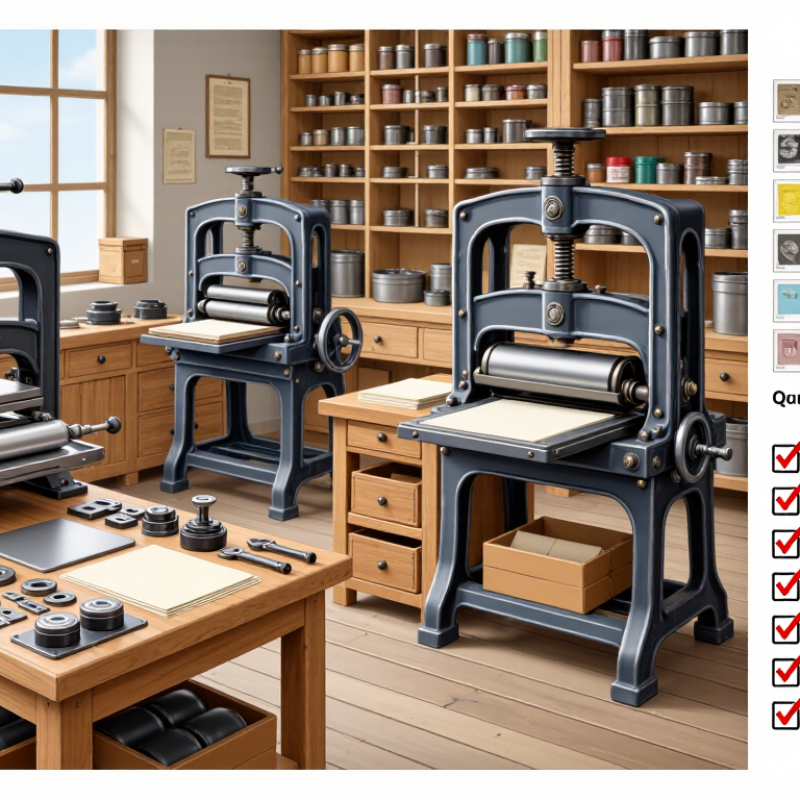
Understanding Tabletop Letterpress Printing Machines
Top Tabletop Letterpress Manufacturers in China
Understanding Tabletop Letterpress Printing Machines
Tabletop letterpress printing machines bring relief printing into a compact format suited to studios, classrooms, and short production runs. Raised type or plates transfer ink through direct pressure onto paper. The impression is tangible: look for crisp edges, an even ink layer, and a slight indentation.
That matters.
Most machines use a hand lever or a small press bed to apply pressure. Their compact size saves workspace, but it does not guarantee effortless printing. Paper thickness, plate height, ink consistency, and pressure all affect the result. A misaligned sheet can leave a faint double image. Even careful operators need test prints.
When comparing machines, check the printable area, construction, adjustment range, and availability of setup guidance. A sturdy frame helps keep pressure consistent, while clear adjustments make repeat jobs easier. Ask how the press handles different paper stocks, and whether common wear parts can be replaced. Small presses have limits; large formats and heavy production may call for other equipment. A sample print is useful, though one good impression cannot prove long-term reliability. Look closely at the details, and leave room for a little trial and error.
The Tabletop Letterpress Manufacturing Landscape in China
Top Tabletop Letterpress Manufacturers in China
The Tabletop Letterpress Manufacturing Landscape in China
China’s tabletop letterpress sector combines small workshops with larger equipment manufacturers. Their machines serve craft studios, print schools, and compact commercial presses. Common design priorities include a stable frame, even platen pressure, and adjustments that operators can manage by hand. These details matter when printing small cards or short-run packaging.
Production capabilities vary. Some factories machine metal parts in-house, while others rely on outside suppliers for components, coatings, or assembly. Buyers often compare bed size, impression consistency, spare-part availability, and shipping protection. A sample print can reveal more than a polished specification sheet. Look closely at fine lines, solid areas, and alignment across the sheet.
The landscape is not perfectly tidy. Similar machines may differ in tolerances, finishing, and the clarity of their operating instructions. That makes direct questions useful: How is platen alignment checked? Which parts wear first? Can replacement components be supplied? A careful factory visit or video inspection helps verify answers. Still, no checklist catches everything. Small inconsistencies sometimes appear only after repeated setup and use.
Leading Tabletop Letterpress Manufacturers in China
Leading Tabletop Letterpress Manufacturers in China
China’s tabletop letterpress suppliers serve craft studios, packaging workshops, and small print rooms. Buyers should compare platen size, pressure adjustment, registration accuracy, and available replacement parts. A compact press must fit the bench, but it also needs enough rigidity to keep impressions consistent. Ask for a printed test sheet. Small details matter.
Smithers’ report The Future of Global Printing to 2027 estimated the global print market at about US$818 billion in 2022, with growth projected through 2027. This figure covers many printing processes; it is not a tabletop letterpress market estimate. Still, it helps explain why reliable, adaptable equipment matters across print production. When evaluating Chinese manufacturers, request machine specifications, a clear operating manual, and close-up samples showing fine lines and solid areas. Check how the supplier handles setup questions and replacement components. A polished demonstration alone is not enough. I may be overly cautious, but a press should be assessed under repeatable conditions, using the same paper and ink planned for actual work.
How to Evaluate and Compare Chinese Manufacturers
Top Tabletop Letterpress Manufacturers in China: How to Evaluate and Compare Chinese Manufacturers
Compare manufacturers by measurable performance, not polished catalog photos. Check the platen’s parallelism, pressure adjustment, repeatability, and usable bed size. Ask for a short video of a complete print run, including setup and paper feeding. Then request samples on your own stock. Fine lines should stay crisp, while solid areas should print evenly. Smithers’ global print market analysis estimated the market at about $818 billion in 2022 and projected roughly $846 billion by 2027. This broad figure signals a competitive print sector; it does not measure tabletop letterpress demand specifically. Use it as context, not proof of a supplier’s quality.
Tips: Ask for the machine’s inspection checklist, warranty terms, spare-parts lead times, and export packing details. Request written tolerances where available. A useful comparison sheet can track these alongside price and delivery time. Confirm what “ready to print” includes; setup requirements vary. Small gaps in documentation matter.
A factory visit or live video call can reveal details photos miss: worn guides, uneven ink coverage, or a noisy drive. Ask the maker to print the same design several times, then compare registration and impression. Verify electrical specifications and available local service before paying a deposit. One imperfect sample is not automatically a deal-breaker, but the supplier should explain the cause and corrective steps. The uncomfortable part: the cheapest press may cost more in downtime. Keep your criteria consistent, and record what each supplier cannot confirm.
Top Tabletop Letterpress Manufacturers in China: How to Evaluate and Compare
Suggested evaluation weights for comparing suppliers. These are a buyer’s scoring framework, not measured results for specific manufacturers.
Score each supplier against the same criteria using documented evidence, such as sample prints, machine specifications, quality records, written lead-time commitments, and service terms. The weights total 100 points and can be adjusted to fit your project.