

nbc logo (2)
Office address
National Engineering Industries Ltd.
Khatipura Road Jaipur – 302006 Rajasthan, India
Phone Number

Toll Free: 1800 3000 6222
Telephone: +91 141 222 3221
Fax: +91 141 222 1926, 222 2259
CIN: U29130WB1946PLC013643

Who Are the Top Steel Pipe Manufacturers in China?

China’s steel industry operates at an exceptional scale. The World Steel Association’s World Steel in Figures 2025 reports that China produced approximately 1,005 million tonnes of crude steel in 2024. That figure provides useful context, but it is not a measure of Steel Pipe output. Pipe capacity, product mix, and quality can vary considerably between manufacturers.

A ranking can still mislead. The most suitable supplier depends on the application: a pipeline project, a boiler system, and a structural frame require different products and evidence. This guide examines leading Chinese manufacturers through practical criteria, including product range, production capabilities, recognized standards, export experience, and quality-control processes. Buyers should verify applicable specifications, mill test certificates, dimensional tolerances, and inspection records directly with each supplier. A polished catalogue is not enough.

Small details matter. A clearly documented heat number, for example, helps connect a delivered pipe to its production and inspection records. Company claims should also be checked against current certificates and project requirements, since capabilities and approvals can change. The World Steel Association’s national production figures describe the broader steel sector, not the performance of any individual pipe mill. That distinction is easy to overlook. The comparisons that follow therefore focus on verifiable manufacturer information, while recognizing that no single supplier is best for every project.
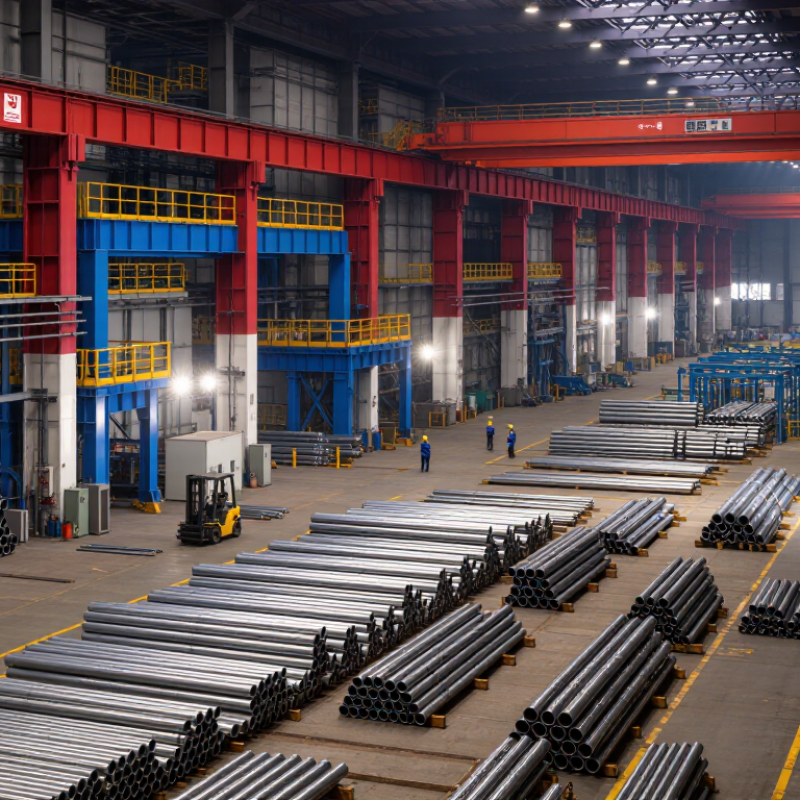
Who Are the Top Steel Pipe Manufacturers in China?

How China’s Steel Pipe Manufacturing Industry Is Organized

China’s steel pipe industry is organized around several kinds of producers, rather than a single group of interchangeable factories. Large integrated mills may control steelmaking and pipe production, while specialized plants focus on particular materials, diameters, or manufacturing processes. Regional industrial clusters connect these mills with steel suppliers, component makers, inspection services, and freight networks. The structure can shorten delivery routes, but it also makes supplier capabilities uneven.

Production methods shape what each facility can offer. Welded pipe is formed from steel strip or plate, then joined along a seam; seamless pipe is made through a different process and serves distinct requirements. A factory’s equipment, heat-treatment capacity, and finishing lines influence its available sizes and tolerances. Details matter. A coating line, for example, may affect corrosion protection and lead time. Buyers can ask for current test records, material traceability, and clear descriptions of inspection procedures. Paperwork helps, but it does not replace checking whether the stated process matches the product ordered. Even within one industrial cluster, quality systems and production schedules can differ, and that is easy to underestimate.

What Makes a Steel Pipe Manufacturer a Market Leader

A market-leading steel pipe manufacturer proves consistency, not merely production scale. The World Steel Association’s World Steel in Figures 2024 reports that China produced 1,019.1 million tonnes of crude steel in 2023, about 54% of the global total. That is a vast industrial base, but it does not guarantee dependable pipe. Buyers should examine mill-test certificates, heat-number traceability, dimensional tolerances, and documented inspection results.

Technical control shows up in small details: a measured wall thickness, a clean weld seam, and records linking each pipe to its steel heat. Manufacturers supplying line pipe should demonstrate conformity with applicable specifications, such as API 5L or ISO 3183, and explain how they test strength, toughness, and weld integrity. Ask for recent third-party inspection records, not just a polished brochure. A capable mill should also describe how it handles nonconforming batches. No process is perfect.

Delivery performance matters too. The World Steel Association’s October 2024 Short Range Outlook forecast global steel demand of 1.75 billion tonnes in 2024 and 1.77 billion in 2025, a reminder that demand shifts can affect schedules and input costs. Strong manufacturers communicate lead-time changes early and protect product traceability during busy periods. Price and capacity are easy to compare; consistency across repeat orders is harder. It deserves scrutiny.

Major Steel Pipe Manufacturers in China

China’s major steel pipe manufacturers serve construction, energy, water, machinery, and infrastructure projects. Their capabilities vary: some focus on seamless pipe, while others produce welded or spiral-welded products in different diameter ranges. Buyers should compare manufacturing method, steel grade, wall thickness, tolerances, and end finish with project drawings. A low quote may conceal differences in inspection scope or delivery condition.

Reliable suppliers document material traceability and test results, and explain controls for forming, welding, heat treatment, and dimensional checks. Ask for current certificates, sample inspection records, and clear acceptance criteria before ordering. For demanding applications, confirm relevant standards and inspection needs with the project engineer; requirements depend on use and location. Factory capacity matters, but a large production line alone does not guarantee consistent batches.

Tips: Request a sample data package and check that its heat number matches the pipe markings. Review packaging, rust protection, and loading photos before shipment. Details matter. I would not judge a manufacturer by catalog claims alone; schedules and communication can shift, so confirm both in writing.

Who Are the Top Steel Pipe Manufacturers in China? - Major Steel Pipe Manufacturers in China

This comparison summarizes major steel pipe manufacturer types and capabilities without naming companies or brands. It is a product-category overview, not a company ranking; available specifications vary by producer and order.

Manufacturer Profile Typical Products Common Manufacturing Routes Relevant Standards Typical Applications Key Buyer Checks
Seamless carbon and alloy pipe producers Seamless line, structural, mechanical, and pressure-service pipe Hot piercing and rolling; some products may receive cold drawing or other finishing processes ASTM A106/A106M; ASTM A53/A53M; applicable product and order specifications Industrial piping, power generation, oil and gas, mechanical equipment, and construction Confirm grade, dimensions, heat treatment, inspection requirements, and traceability against the purchase specification
Welded line pipe producers Longitudinally welded or helical-welded line pipe Forming and welding of steel plate or coil; inspection and testing depend on the specified product requirements API Specification 5L; other project-specific requirements may also apply Oil, gas, water, and other pipeline transportation systems Check pipe grade, outside diameter, wall thickness, weld inspection, testing, coating requirements, and edition of the specified standard
Oil-country tubular goods (OCTG) producers Casing and tubing for wells Seamless or welded production, followed by finishing and threading as required by the product specification API Specification 5CT, where specified Oil and gas well construction and production Verify grade, dimensions, connection type, thread inspection, markings, and required test documentation
Large-diameter welded pipe producers Large-diameter longitudinal or helical-welded pipe Plate forming with longitudinal or helical welding, followed by specified nondestructive examination and testing API Specification 5L or project-specific standards, where applicable Long-distance pipelines, water transmission, infrastructure, and structural projects Review dimensional tolerances, weld examination, hydrostatic testing, coating system, and project acceptance criteria
Stainless and corrosion-resistant pipe producers Seamless and welded stainless steel pipe in specified grades and dimensions Hot forming, cold working, or welded forming routes, depending on product type ASTM A312/A312M for specified austenitic stainless steel pipe products; confirm the applicable grade and product scope Chemical processing, food and beverage, water treatment, and corrosive-service systems Confirm alloy grade, manufacturing route, heat treatment, corrosion-service requirements, and surface condition
Precision and mechanical tube producers Small-diameter or close-tolerance tubes for mechanical use Cold drawing, cold rolling, or other precision-finishing processes, depending on the product Applicable ASTM, EN, or customer specifications selected for the intended application Automotive components, machinery, hydraulic systems, and general engineering Check tolerances, straightness, surface finish, mechanical properties, and inspection documentation

Key Products and Industries Served by Leading Manufacturers

Leading Chinese steel pipe manufacturers serve very different jobs, so product range matters more than a broad “top supplier” label. Common offerings include seamless pipe for pressure and heat, ERW pipe for water and structural uses, and large-diameter submerged-arc-welded pipe for long-distance transmission. Some suppliers also make casing and tubing for wells, boiler tubes for power plants, and precision tubes for machinery. Fit matters.

The World Steel Association’s World Steel in Figures 2024 reports that China produced 1,019.1 million tonnes of crude steel in 2023, about 54% of global output. That scale supports a deep supply chain, but it does not prove that every mill can meet pipe-specific requirements. Buyers should check grade, wall thickness, testing records, weld inspection, and traceability against the intended service conditions. A strong general catalog is not a substitute for verified capacity.

Industry demand shapes the details. Oil and gas projects often require line pipe, casing, and corrosion-resistant specifications; municipal water systems need durable transmission pipe and consistent coatings. Construction uses structural tubes for columns, scaffolding, and industrial frames, while power facilities need tubes able to withstand heat and pressure. The World Steel Association’s 2024 report provides useful context on production scale, yet it does not rank pipe makers. Catalog descriptions can blur important differences; even experienced buyers may need to confirm dimensions and inspection scope directly.

How to Compare Chinese Steel Pipe Manufacturers

Comparing Chinese steel pipe manufacturers starts with matching the product to its service conditions. Specify pipe type, grade, outside diameter, wall thickness, length, and applicable standard before requesting quotes. A low price means little if one supplier quotes welded pipe and another quotes seamless pipe. Check mill test certificates, heat-number traceability, dimensional inspection records, and documented non-destructive testing. Ask for a sample certificate and a recent inspection report. Details matter.

Capacity needs context. The World Steel Association’s World Steel in Figures 2025 reports that China produced about 1,005 million tonnes of crude steel in 2024. That scale does not prove any individual pipe mill’s consistency. Compare verified output for the exact pipe process and size range you need. Review production lead times, defect and rejection records, packaging, and how claims are handled. Request a third-party audit when records are incomplete. A polished brochure is not evidence. I would also compare the supplier’s answers with a trial order; paperwork can look sound while delivery performance remains uncertain. Keep the scoring simple: technical compliance, quality evidence, delivery reliability, and total landed cost.

Compare manufacturers by checking whether their product specifications and inspection certificates meet the pipe grade and minimum yield strength your project requires. Values shown are minimum yield strengths for selected API 5L grades; they are not manufacturer ratings.

Article Source: