
Toll Free: 1800 3000 6222
Telephone: +91 141 222 3221
Fax: +91 141 222 1926, 222 2259
CIN: U29130WB1946PLC013643
Founded in 1946, National Engineering Industries Ltd (NEI) is India’s leading bearings manufacturer and exporter, renowned for excellence in quality and delivery.

A needle roller bearing uses long, slender rollers to carry loads within a compact space. Its small cross-section can help designers save radial room in gearboxes, pumps, automotive assemblies, and industrial machinery. But “needle bearing” does not describe just one construction. Caged, full-complement, drawn-cup, and thrust designs differ in load direction, speed limits, mounting needs, and lubrication requirements. Small details matter.
Industry reports provide useful context. Grand View Research’s bearing-market analysis discusses demand across bearing products and applications, while SKF’s Rolling Bearings Catalogue offers technical guidance on bearing arrangements and selection. These sources serve different purposes: market research tracks broad trends, while engineering references help explain operating conditions. Neither replaces checking a specific manufacturer’s load ratings, tolerances, and installation instructions. That distinction is easy to miss.
This guide introduces ten common needle roller bearing types and the situations each may suit. It considers features such as whether the bearing includes an inner ring, uses a cage, or supports axial loads. A drawn-cup unit, for example, can fit tightly into a housing, while a thrust design handles force along a shaft. The right choice depends on more than dimensions. Speed, shock loads, shaft hardness, lubrication, and available space all matter. Catalog labels can still confuse, especially when similar designs have different limits. A careful comparison is worthwhile.
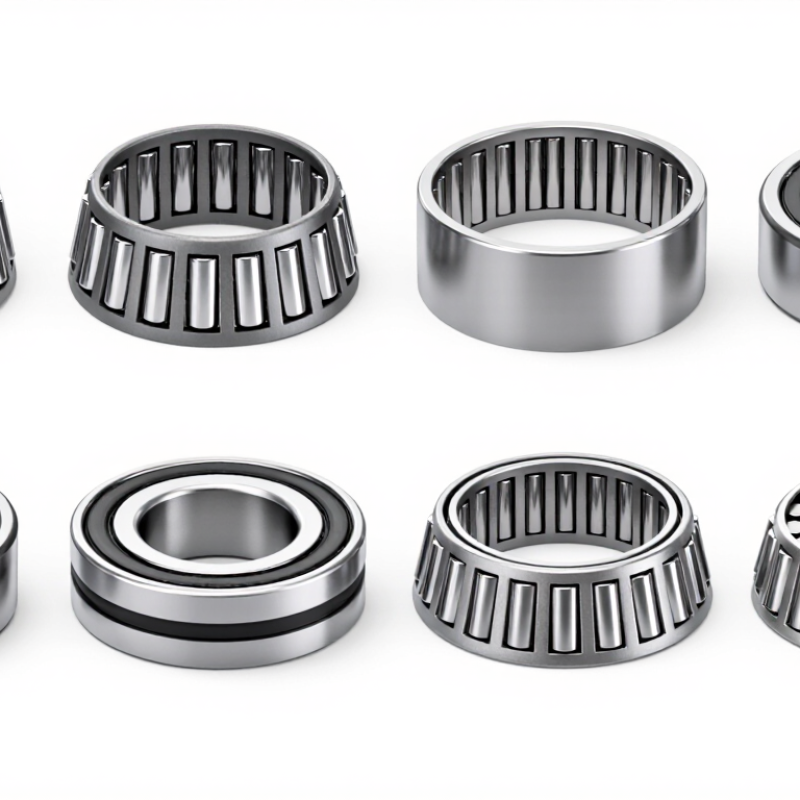
A needle roller bearing uses long, slender rollers to carry radial loads in a compact space. Its rollers are much longer than their diameter, creating a relatively large contact area without requiring a bulky bearing cross-section.
Small space. High load.
In a drawn-cup design, a thin outer shell holds the rollers; other designs use a machined outer ring or rely on a hardened shaft as a raceway.
During operation, the rollers rotate between the raceways as the shaft turns. Their line contact spreads the load, while rolling motion reduces friction compared with direct sliding.
But the simple diagram misses real-world details: poor lubrication, contamination, or shaft misalignment can quickly increase wear. Many needle roller bearings mainly support radial loads, so check the application before expecting axial support.
For life estimates, ISO 281:2007 gives the basic rating-life relationship for roller bearings: L10 = (C/P)10/3 million revolutions. Here, C is the basic dynamic load rating and P is the equivalent dynamic load. L10 represents a statistical life at which 90% of a sufficiently large group of identical bearings may be expected to survive under specified conditions. It is a useful design reference, not a promise for every installation. Actual service life depends on fit, lubrication, load, and operating environment.
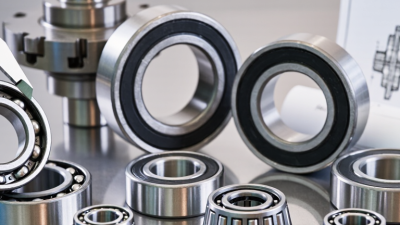
Needle roller bearings use long, thin rollers to carry radial loads in limited space. Their main components are needle rollers, raceways, and, in many designs, a cage. The rollers make line contact with the raceways, spreading load across a narrow track. A cage keeps rollers separated and helps guide them during rotation. Some bearings have an inner ring; others run directly on a hardened shaft. Small details matter.
Design features vary across the ten common types, including drawn-cup, solid-ring, and thrust needle bearings. Drawn-cup designs use a thin outer shell and suit compact housings. Solid-ring types provide stronger, more precise raceways. Thrust designs support axial loads with flat washers and rollers. Full-complement versions fit more rollers, but increased roller contact can raise friction. End flanges, seals, and lubrication paths also affect alignment, contamination protection, and service life. Clearance deserves attention; a fit that seems convenient may leave too little running room.
Tips: Check shaft hardness, housing dimensions, and load direction before choosing a bearing. Apply the lubricant specified for the operating conditions, and keep installation tools square to the shaft. A slight tilt can damage the raceway. In practice, measuring again is rarely wasted effort.
Core components and key design features across common bearing configurations
Each colored segment marks a feature typically present in the listed configuration: radial outer ring, inner ring, cage, seal, or thrust section. The bars count feature categories, not rollers or performance; configurations can vary by design.
Needle roller bearings use long, thin rollers to carry radial loads in compact spaces. Drawn-cup open-end bearings have a thin outer shell and suit housings with limited room. Their closed-end cousins also protect one end of the shaft. Machined-ring needle bearings use thicker, more rigid rings for demanding fits. Caged needle bearings separate the rollers, reducing friction at higher speeds. Space is tight.
Full-complement bearings pack in more rollers and can support heavier loads, though they may run more slowly. Thrust needle bearings handle axial force between flat washers; they do not replace radial support. Combined radial-thrust bearings bring both functions into one assembly, which can simplify a compact mechanism. Self-aligning needle bearings tolerate limited misalignment, but they cannot correct a badly misaligned shaft. These categories sometimes overlap, so a top-ten list is not perfectly tidy.
Track rollers carry loads along rails or cam paths, often with a thick outer ring. Stud-type cam followers mount directly to a frame and roll against a moving surface. Needle-roller one-way clutches transmit torque in one direction and overrun in the other. The right type depends on load direction, speed, available space, and lubrication. Measure the shaft and housing carefully; small fit errors can change how a bearing performs. Check rated loads and operating limits before choosing.
| No. | Bearing Type | Typical Construction | Main Characteristics | Common Applications |
|---|---|---|---|---|
| 1 | Open-End Drawn-Cup Needle Roller Bearing | A thin, formed outer shell holds needle rollers, usually guided by a cage; both ends are open. | Compact radial design with a small cross-section. It commonly runs directly on a hardened, ground shaft when no inner ring is fitted. | Gearboxes, small appliances, pumps, and compact machinery. |
| 2 | Closed-End Drawn-Cup Needle Roller Bearing | A drawn-cup outer shell with one closed end, generally containing a caged set of needle rollers. | The closed end can seal off the bearing cavity and support applications where the shaft does not pass through the housing. | Blind-end shaft locations, small transmissions, and compact mechanisms. |
| 3 | Machined-Ring Bearing Without Flanges | A precision-machined outer ring contains needle rollers and a cage, without integral side flanges. | Suitable for higher loads than many thin-shell designs when adequate housing and shaft support are provided. Separate axial guidance is usually needed. | Industrial gearboxes, construction equipment, and general machinery. |
| 4 | Machined-Ring Bearing With Flanges | A machined outer ring with integral flanges that help guide the roller-and-cage assembly. | Flanges provide axial guidance for the rolling elements, but the bearing is not intended to carry substantial external axial loads. | Rotating shafts and mechanisms where compact axial guidance is useful. |
| 5 | Full-Complement Needle Roller Bearing | Needle rollers are arranged without a cage, allowing more rollers to fit in the available space. | High radial load capacity for its size; maximum speed is generally lower than that of a comparable caged design because roller-to-roller contact increases friction. | Slow- to moderate-speed, heavily loaded pivots, presses, and support points. |
| 6 | Caged Needle Roller Bearing | A cage separates and guides the needle rollers in a drawn-cup or machined-ring arrangement. | The cage reduces roller-to-roller friction and helps the bearing operate at higher speeds than a comparable full-complement design. | Engines, transmissions, pumps, and other applications with frequent rotation. |
| 7 | Needle Roller Bearing With Inner Ring | An inner ring provides a dedicated hardened raceway between the rollers and the shaft. | Useful when the shaft cannot serve as a suitable raceway. The inner ring adds radial space compared with a bearing running directly on a prepared shaft. | Replacement assemblies and designs using shafts that are not hardened or ground. |
| 8 | Needle Roller Bearing Without Inner Ring | The needle rollers run directly on a hardened, ground shaft; the bearing assembly includes an outer ring and rollers. | Provides a compact arrangement and can allow a larger shaft diameter within a given housing size. The shaft surface must meet raceway requirements. | Space-limited gearboxes, engine components, and compact machinery. |
| 9 | Thrust Needle Roller Bearing | A cage holds needle rollers arranged between hardened thrust raceways or washers. | Designed to carry axial load in one direction. It does not provide radial support on its own, and the raceways must be adequately supported. | Thrust positions in gearboxes, machine tools, and automotive assemblies. |
| 10 | Combined Needle Roller / Angular-Contact Ball Bearing | A radial needle roller bearing is integrated with an angular-contact ball bearing in one assembly. | Combines high radial-load capacity from the needle rollers with axial-load capacity from the angular-contact ball bearing; load direction and capacity depend on the design. | Machine-tool spindles, screw drives, and mechanisms subject to both radial and axial loads. |
The ten common forms include drawn-cup, solid-ring, caged, full-complement, thrust, combined, self-aligning, sealed, track-roller, and needle-roller-and-cage types. Their mounting needs differ. Drawn-cup bearings press into a housing and rely on a precise bore for support. Solid-ring designs usually need a shaft shoulder or retaining ring. Needle-roller-and-cage assemblies need hardened, accurately finished shaft and housing raceways. Fit matters.
Performance depends on load, speed, lubrication, and available space. Caged designs leave room for lubricant and suit higher speeds; full-complement types fit more rollers and can carry heavier loads, but roller-to-roller contact limits speed. Thrust types handle axial loads, not radial loads, unless paired with a radial bearing. ISO 281:2007 sets out the basic rating-life method and its 90% reliability basis under specified conditions. It is a calculation, not a service-life promise. A soft shaft or poor lubrication can undermine an otherwise suitable choice.
Tips: Check housing-bore tolerance, shaft hardness, and lubrication access before fitting. For a tight assembly, verify clearances after mounting; press fits can reduce internal clearance. These details are easy to overlook, and real operating conditions may change the best choice.
Needle roller bearings fit radial-load applications where housing space is limited. Drawn-cup types often serve compact gearboxes and appliance pivots. Solid-race designs suit machine tools and pumps. Caged versions generally allow higher speeds, while full-complement designs carry heavier loads at lower speeds. Thrust needle bearings handle axial loads; track rollers follow cams and conveyor tracks. The application decides.
Selection starts with load direction, speed, shock, and available space. Check shaft hardness and finish, too. A small bearing on a soft shaft can wear quickly; it cannot replace a proper raceway. ISO 281:2007 defines basic L10 rating life at 90% reliability under specified conditions. That is a statistical rating, not a service-life guarantee. Fits, misalignment, lubrication, and contamination can change actual life.
ISO 15243:2017 groups rolling-bearing damage into six categories, including fatigue, wear, corrosion, and plastic deformation. Inspect failures before selecting a larger bearing. That step is often skipped. Polished raceways may suggest lubrication problems, while dents can point to debris or handling damage. But diagnosis needs context. Validate temperature and noise during a controlled run-in.
Copyright © 2023 NEI Ltd. All rights reserved.
Registered Office : 9/1, R. N. Mukherjee Road, Kolkata – 700 001. In case of any queries or grievances, please contact Mr.Tarun Kumar Kabra, Company Secretary.
E-mail: sale@kinpart.com Privacy Policy Cookie Policy