

A Belt Speed Control Inverter helps match conveyor speed to changing production needs. On a packing line, that can mean slowing a belt as cartons approach a scanner or keeping material flow steady between machines. The right model can support smoother starts, controlled stopping, and more consistent operation. Small details matter. Motor type, rated current, required speed range, braking needs, and the conveyor’s load should all shape the selection.
This guide to China Top 10 Belt Speed Control Inverter Manufacturers is intended to help buyers compare suppliers, not treat a ranking as a guarantee. Manufacturer specifications, product availability, and service coverage can change, so check current datasheets and confirm key figures directly. Look closely at overload capacity, enclosure protection, control interfaces, documentation, and technical support. Ask how the inverter behaves when a belt is heavily loaded or starts frequently. Those practical questions can reveal more than a headline power rating.
There is no universal best choice. A compact workshop conveyor and a long, loaded production belt place different demands on equipment. This overview considers product range, application fit, stated technical information, and support options. These points are useful, but they cannot replace a site assessment or a verified quotation. A comparison can still miss something. That is why buyers should confirm compatibility with the motor, control system, and operating environment before making a final decision.
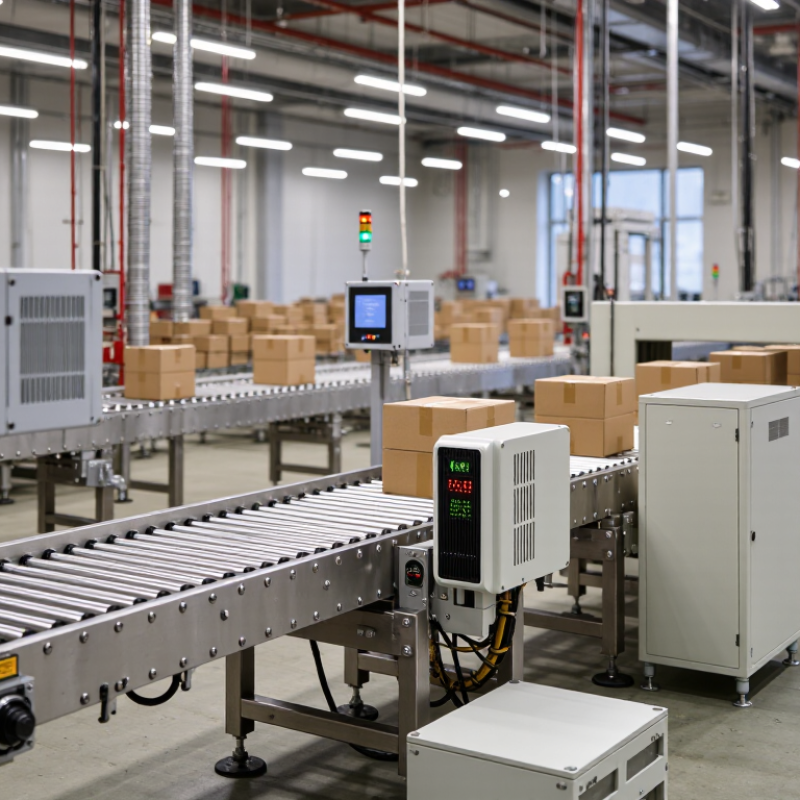
A belt speed control inverter changes the frequency and voltage supplied to an electric motor, allowing a conveyor belt to run at a chosen speed. In practical terms, an operator can slow a belt carrying fragile parts or increase its pace when material arrives steadily. The inverter can also ramp the motor up and down, rather than starting abruptly. Less jolting. This may reduce mechanical stress, though results depend on belt loading, motor selection, and maintenance.
The IEA’s 2011 report, Energy-Efficiency Policy Opportunities for Electric Motor-Driven Systems, estimates that motor-driven systems use about 45% of global electricity. The U.S. Department of Energy’s 2014 motor systems sourcebook reports that motors account for roughly 68% of U.S. industrial electricity use. These figures explain why controlling motor speed can matter, but they do not guarantee a specific energy saving for every conveyor. A belt running near full speed all day may gain little from speed adjustment. Operators should compare power use and throughput before and after installation, and check motor temperature, belt tension, and inverter settings. Real measurements beat assumptions.
| No. | Control Function | What the Inverter Does | Practical Conveyor Effect | Selection Consideration |
|---|---|---|---|---|
| 1 | Variable-speed operation | Changes the frequency supplied to an AC motor to adjust its rotational speed. | Lets operators adjust belt speed to suit the process rather than running continuously at one fixed speed. | Check the motor type, required speed range, and whether adequate torque is available at low speed. |
| 2 | Soft starting | Ramps the motor frequency and voltage up during startup instead of applying full-speed operation immediately. | Can reduce abrupt belt acceleration and lessen mechanical shock to the drive train and conveyed load. | Set acceleration time to suit the load and confirm that the motor can start the conveyor under its expected load. |
| 3 | Controlled stopping | Ramps the motor down to a stop; some systems can use braking equipment when a faster or more controlled stop is required. | Helps avoid an unnecessarily abrupt stop and can support coordinated shutdowns in a production line. | Consider conveyor inertia, stopping time, downhill loads, and whether a braking resistor or other braking method is needed. |
| 4 | Process speed matching | Accepts a speed reference from an operator panel, control system, or compatible analog or digital input. | Allows belt speed to be coordinated with upstream and downstream equipment. | Verify available control inputs, signal type, communication interface, and the control system’s requirements. |
| 5 | Motor overload protection | Monitors operating conditions and can trip or limit operation when configured protection thresholds are exceeded. | Can help protect the motor and drive system from certain overload conditions. | Enter the motor nameplate data correctly; inverter protection does not replace suitable electrical and mechanical safeguards. |
| 6 | Torque and load handling | Controls motor output using a selected drive mode, such as volts-per-hertz control or a form of vector control, depending on the model. | Supports conveyor operation as load changes, provided the drive, motor, and control mode are suitably selected. | Assess starting torque, load variation, speed range, motor compatibility, and any required tuning. |
| 7 | Energy use adjustment | Allows motor speed to be reduced when the process does not require full speed. | May reduce energy use when operating conditions permit lower speed; actual savings depend on the system and duty cycle. | Compare the real operating profile and motor load before estimating energy savings. |
| 8 | Preset speed selection | Can switch among configured speed references when the inverter supports preset-speed functions and the required inputs are wired. | Provides repeatable operating speeds for different product types or process stages. | Check the number of supported presets and how commands are integrated with the machine controls. |
| 9 | Fault monitoring and diagnostics | Displays or reports drive conditions and fault codes; available monitoring and communication features vary by model. | Helps maintenance staff identify drive-related issues and review operating status. | Confirm which alarms, status signals, event records, and communication protocols are available. |
| 10 | Reversible operation | Can command motor rotation in either direction when the drive, motor, wiring, and application support reversing. | May support belt clearing or bidirectional material movement on suitably designed conveyors. | Check mechanical suitability, interlocks, stopping requirements, and safe operating procedures before enabling reverse. |