What Are Rolling Tool Carts and How Do They Work?
Rolling Tool Carts are mobile storage systems designed to keep hand tools, small equipment, and supplies within easy reach. They usually combine a steel or reinforced plastic frame, several drawers, open shelves, and swivel casters. Some models include locking drawers, side hooks, work surfaces, or built-in power strips. The basic idea is simple: store tools near the task, then move the entire setup when the job changes.
A rolling cart can reduce wasted steps in a garage, workshop, maintenance room, or professional service area. Its drawers help separate sockets, screwdrivers, fasteners, and measuring tools. Larger wheels may cross concrete floors more smoothly, while locking casters help stabilize the cart during use. However, mobility does not guarantee safety or efficiency. An overloaded drawer can affect balance, and poorly distributed weight may make steering difficult. That detail is easy to overlook.
The best cart depends on the work, available floor space, and expected load. A mechanic may value deep drawers and a strong steel top. A technician may need compact storage and quick access to delicate instruments. Materials, drawer ratings, wheel quality, and lock design deserve careful comparison. Marketing claims can sound impressive. Real workshop conditions are less forgiving.
This guide explains how Rolling Tool Carts are built, how their parts work together, and where their practical limits appear. It also considers maintenance, organization, and safe movement. Some assumptions may need questioning, especially the belief that a larger cart is always better. In practice, the right cart is the one that supports a clear workflow without becoming another obstacle.
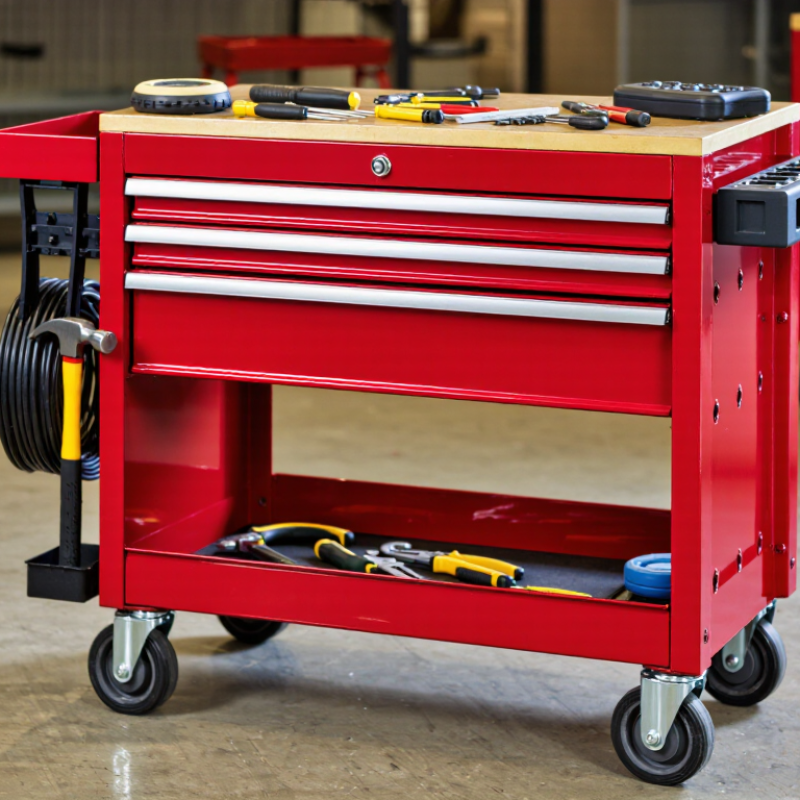
Definition and Purpose: Mobile Storage Built for 500–1,000 lb Tool Loads
Rolling tool carts are mobile storage units designed to carry demanding workshop loads, commonly between 500 and 1,000 pounds. They combine a welded frame, shelves or drawers, and heavy-duty casters. The casters let technicians move tools across concrete floors without unloading everything. Locking wheels keep the cart steady during repairs. Stronger models also use reinforced shelves, thicker drawer slides, and a low center of gravity.
The rated capacity matters, but it is not the whole story. A 1,000-pound rating may assume an even load across every shelf. Concentrating heavy equipment in one drawer can strain the frame and make the cart unstable. In practical workshop use, spreading weight low and evenly improves control. A cart should also fit through doorways, around benches, and beside other equipment. Small design details matter. Handles, wheel clearance, and drawer extension affect daily safety and efficiency. Capacity ratings can be misunderstood, so checking the technical specifications remains essential.
Tips: Place the heaviest tools on the bottom shelf. Engage wheel brakes before opening loaded drawers. Inspect casters, welds, and drawer slides regularly. Do not push a fully loaded cart across damaged flooring without testing its stability. Even experienced users can misjudge momentum. A strong cart is helpful, but careful loading still decides how safely it works.
Core Components: Steel Frames, Drawers, Handles, and 4–6 in Casters
What Are Rolling Tool Carts and How Do They Work?
Core Components: Steel Frames, Drawers, Handles, and 4–6 in Casters
A rolling tool cart is a mobile workstation built around a rigid steel frame. The frame carries drawers, shelves, and changing loads without twisting easily. Drawers organize sockets, drivers, and small parts, while full-extension slides improve visibility. However, a loaded drawer can shift the center of gravity. That detail is easy to miss.
The handle transfers pushing force into the frame. A secure, rounded grip reduces awkward wrist angles during movement. Four to six-inch casters provide the cart’s contact with the floor. Four-inch casters usually turn more easily in tight spaces. Six-inch casters typically pass small thresholds with less resistance. Their load rating must exceed the cart’s weight plus its contents. The U.S. Bureau of Labor Statistics reported about 2.6 million nonfatal private-industry injuries and illnesses in 2023. That figure does not prove carts prevent injuries, but it supports careful ergonomic design. OSHA guidance also favors stable loads, clear routes, and controlled pushing.
Tips: Load heavy tools in the lowest drawers. Keep the handle side clear. Test the cart on the actual floor, not a showroom surface. Check caster bolts and wheel wear regularly. A cart may feel stable when empty, then flex under uneven weight. This is where specifications alone can mislead. Recheck performance after real use.
Load Distribution: Center of Gravity, Drawer Capacity, and Stability Factors
What Are Rolling Tool Carts and How Do They Work?
A rolling tool cart moves equipment through casters, drawers, and a rigid frame. Its safety depends on load distribution, not drawer count. Keep heavy tools low and near the cart’s centerline. This lowers the center of gravity and reduces tipping during turns. A fully extended drawer shifts weight forward. Several open drawers can create a dangerous leverage effect. Real workshops are messier than spreadsheets.
Drawer capacity must include both static and moving loads. A drawer rated for 45 kilograms may behave differently when a heavy tool lands suddenly. Check the manufacturer’s rating, then leave practical headroom. OSHA material-handling guidance emphasizes stable storage and controlled movement. The U.S. Bureau of Labor Statistics reported that falls, slips, and trips represented about one-fifth of private-industry cases involving days away from work in 2023. A tipping cart can create the same sudden loss of control. Wheel diameter, floor condition, caster spacing, and handle height also affect pushing force. NIOSH ergonomic research consistently links excessive push force with poor wheel resistance and awkward posture.
Tips: Place dense tools in bottom drawers. Open one drawer at a time. Push slowly, especially across thresholds. Lock casters before loading. Inspect loose wheels, bent slides, and uneven floors weekly. Do not trust a capacity label blindly; uneven loading can reduce real-world stability. A perfect calculation still misses a cracked wheel.
Rolling Tool Carts: Load Distribution and Stability
Representative 5-drawer cart scenario showing how usable load capacity is distributed by drawer position. Heavier tools are typically placed in lower drawers to keep the center of gravity low and improve stability during movement.
The example assumes a total working load of 97 kg across five drawers. Lower drawers have higher representative capacities because placing dense loads closer to the base generally reduces tipping risk. Actual limits depend on the cart structure, caster design, wheelbase, drawer extension, and floor conditions.
Safe Operation: Locking Systems, Weight Limits, and OSHA-Aligned Practices
Rolling tool carts are mobile workstations with shelves, drawers, casters, and locking systems. They keep hand tools close while reducing repeated carrying across a workshop. Safe operation depends on more than smooth wheels. A cart can become unstable when heavy drawers are opened together or tools shift during movement.
Check the rated capacity before loading. Never assume every shelf supports the same weight. Place dense tools low, center the load, and keep handles clear. OSHA’s 29 CFR 1910.176(b) requires stored materials to remain stable and secure against sliding or collapse. The Liberty Mutual Workplace Safety Index estimated that serious workplace injuries cost U.S. employers $58.5 billion in 2021. Overexertion accounted for about $12.7 billion, making unnecessary pushing and lifting worth reconsidering.
Locking systems need a practical test. Engage the caster brakes before opening drawers, working on a part, or parking on a slope. A drawer lock should prevent unintended opening during movement, not merely close the front. Push the cart; do not pull it blindly around corners. OSHA’s walking-working-surface guidance also stresses clear, orderly routes and prompt correction of hazards.
Small habits matter. Inspect casters, handles, brakes, and drawer latches at the start of each shift. Remove oil, loose bolts, and damaged wheels. Do not overload it. Workers should receive task-specific training, although training alone cannot correct a poor layout. In real workshops, people sometimes exceed the posted limit “for one quick move.” That shortcut deserves a hard second look.