

Toll Free: 1800 3000 6222
Telephone: +91 141 222 3221
Fax: +91 141 222 1926, 222 2259
CIN: U29130WB1946PLC013643
Founded in 1946, National Engineering Industries Ltd (NEI) is India’s leading bearings manufacturer and exporter, renowned for excellence in quality and delivery.

Choosing the right Electrical Sockets is not merely a matter of matching a plug to a wall plate. The right choice depends on the circuit, the room, the expected load, and the people using it. A socket beside a kitchen counter faces different demands from one in a quiet bedroom. Look closely at the rating, terminal condition, grounding arrangement, and compatibility with local wiring. Small details matter.
Electrical instructor and author Mike Holt is known for practical training on electrical systems. A careful paraphrase of the safety principle behind that work is: “Match each electrical device to its circuit and intended use.” This is a paraphrase, not a verbatim quotation. It offers a useful starting point, but it cannot replace advice from a qualified electrician who can inspect the actual installation.
The outline ahead considers socket types, ratings, materials, safety features, and room-specific needs. It also explains why a familiar-looking socket may still be unsuitable. In damp areas, for example, the required protection depends on the location and applicable local standards. Check product documentation rather than relying on appearance alone. That part is easy to overlook.
A socket’s price or polished finish tells little about its suitability. Compare specifications, confirm compatibility, and seek professional help when wiring conditions are unclear. Even a simple replacement can reveal older or damaged wiring. That deserves a pause. Choosing well means balancing everyday convenience with verified safety—and admitting when a closer inspection is needed.
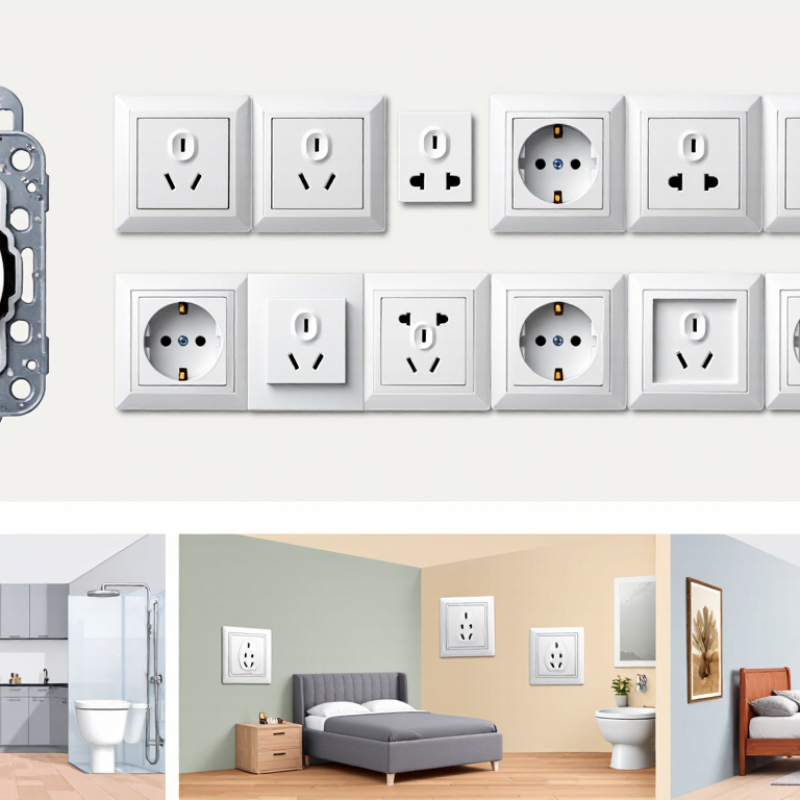
Electrical socket types differ in pin shape, grounding, shutter design, and rated voltage. A plug that fits is not automatically a safe match. Check the appliance label and the socket’s rating before choosing a configuration. For example, IEC 60884-1:2022 covers household and similar plugs and socket-outlets rated up to 440 volts AC and 32 amperes. Local standards still determine which configurations are suitable.
Configuration also affects protection. Grounding provides a path for fault current, while shutters can help prevent objects entering unused openings. In kitchens, bathrooms, and other damp areas, suitable residual-current protection may be required by local rules. Details matter. A tidy faceplate can hide an incompatible rating or missing protection, so inspect the markings rather than relying on appearance.
The risk is real, though not limited to sockets. NFPA’s report on U.S. home electrical fires estimated 46,700 fires annually from electrical failure or malfunction during 2015–2019. That figure covers many electrical causes, not sockets alone. It is a useful reminder to consider the full setup: appliance load, grounding, protection, and the room’s conditions. I would double-check the rating; it is easy to overlook.
| Socket Type | Typical Configuration | Typical Supply | Grounding | Common Use | Key Selection Consideration |
|---|---|---|---|---|---|
| Type A | Two flat parallel pins | Typically 100–127 V, 50 or 60 Hz | Ungrounded | Common in parts of North America and Japan | Use only with compatible ungrounded plugs and equipment; it does not provide a protective earth connection. |
| Type B | Two flat parallel pins and one round grounding pin | Typically 100–127 V, 50 or 60 Hz | Grounded | Common in North America and Japan | Choose a grounded outlet for appliances with three-pin plugs. The outlet and circuit must be properly grounded. |
| Type C | Two round pins; commonly an ungrounded Europlug | Typically 220–240 V, 50 Hz | Ungrounded | Widely used in Europe and in some other regions | Often accepted by compatible E- or F-style sockets, but it is not suitable where an appliance requires grounding. |
| Type E | Two round-pin openings with a projecting grounding pin | Typically 220–240 V, 50 Hz | Grounded | Common in France, Belgium, Poland, and some neighboring countries | Check plug compatibility: the grounding arrangement differs from Type F, although many modern hybrid sockets accept both. |
| Type F | Two round-pin openings with grounding contacts on the sides | Typically 220–240 V, 50 Hz | Grounded | Common in Germany, Spain, and many other European countries | Look for a correctly rated grounded socket. Many Type F sockets also accept compatible Type C plugs. |
| Type G | Three rectangular pins in a triangular arrangement | Typically 220–240 V, 50 Hz | Grounded | Common in the United Kingdom, Ireland, and several other regions | Many installations use fused plugs. Confirm the socket, fuse, and circuit ratings suit the appliance. |
| Type I | Two angled flat pins; grounded versions add a vertical earth pin | Typically 220–240 V, 50 Hz | Grounded or ungrounded, depending on configuration | Common in Australia, New Zealand, and China | Pin dimensions and ratings can vary by country and socket version; verify the specific local standard. |
| Type J | Three round pins in a triangular arrangement | Typically 220–240 V, 50 Hz | Grounded | Common in Switzerland and Liechtenstein | Check the plug’s dimensions and current rating; compatibility with other European plug types is not universal. |

How to Choose the Right Electrical Sockets?
A socket can fit the plug and still be unsuitable. Read the appliance label for its voltage and current, then check the socket and circuit ratings. IEC 60038 identifies 230 V as a standard nominal voltage for electrical systems; actual supply can vary by location. Match the appliance’s stated voltage to the local supply. For a rough current check, divide watts by volts, but follow the appliance’s rated input and installation guidance. Small mismatch. Big risk.
Current matters just as much. IEC 60884-1 covers household plugs and socket-outlets rated up to 440 V AC and 32 A. That is the standard’s scope, not a recommended rating for every home socket. Choose a socket rated for the intended load, and ensure the circuit’s protective device is suitable too. A high-power heater, for example, should not share an overloaded extension lead. If ratings are unclear, ask a qualified electrician.
Check the plug’s pin layout, earthing arrangement, and frequency requirements against the socket and local supply. A travel adapter may change the plug shape; it does not necessarily convert voltage. It is easy to trust a familiar shape. That assumption deserves a second look. Use the IEC ratings as technical reference points, then verify the markings on the actual equipment and socket before connecting it.
Compare the socket’s voltage and current rating with your appliance’s requirements, and make sure the plug matches the socket standard. Values shown are typical nominal supply voltages and maximum socket current ratings: actual supply voltage can vary by location. A plug that physically fits is not, by itself, proof of electrical compatibility.
A socket should match the room, the appliance, and the circuit—not just the wall color. In kitchens, place outlets near work surfaces, away from sinks and heat. Use ground-fault protection where required, and check local electrical rules. Refrigerators and other high-load appliances may need dedicated circuits; confirm this with a qualified electrician.
In bathrooms, choose correctly rated, protected outlets and keep them clear of splash zones. Small details matter.
For bedrooms and living rooms, consider outlet placement beside beds, desks, and media units. USB charging sockets can reduce clutter, but check their output against your devices. Avoid overloading outlets with heaters or multi-plug adapters.
The National Fire Protection Association’s Home Fires Involving Electrical Failure or Malfunction report estimates 46,700 home structure fires per year from 2015–2019, with 390 deaths and $1.5 billion in direct property damage.
Those figures make socket condition and circuit suitability more than cosmetic choices. I still find it easy to focus on convenience first. That deserves a second look.
Replace loose or cracked sockets, and ask a licensed electrician to assess uncertain wiring.
Choosing an electrical socket starts with its safety standard, not its color or shape. IEC 60884-1 covers household plugs and socket-outlets, but countries may adopt different versions or additional requirements. Check the certification mark accepted where the socket will be installed, and match its voltage and current rating to the circuit. A familiar-looking outlet is not automatically suitable.
Protective features address different risks. Shutters can help prevent objects entering live contacts; tamper-resistant designs are especially relevant around children. A residual-current device (RCD), called a GFCI in some regions, can disconnect power when it detects leakage. It complements socket protection rather than replacing correct wiring, grounding, or circuit-breaker protection. Small details matter: a loose plug, cracked faceplate, or warm socket deserves attention.
The risk is measurable. NFPA’s Home Fires Involving Electrical Distribution or Lighting Equipment report, based on 2015–2019 U.S. data, estimates an average of 34,000 home structure fires annually involving this equipment. The report also estimates 470 deaths and 1,100 injuries each year.
These figures cover more than socket failures alone, so they should not be read as a socket-specific risk. A certification label helps, but it cannot confirm that an older installation is sound. For a damp area or an aging outlet, have a qualified electrician check the required protection and wiring.
Plan socket locations around actual routines, not just wall symmetry. Mark the bed, desk, television, and kitchen appliances on a room sketch, then note where cords would naturally run. A socket hidden behind a bookcase is technically present but rarely useful. Small details matter.
Wet areas and high-load appliances need particular care. Ask a qualified electrician to assess circuit capacity, protective devices, and locally required clearances before installation.
The National Fire Protection Association estimated an annual average of 32,620 U.S. home structure fires involving electrical distribution or lighting equipment in 2015–2019 (NFPA, Home Electrical Fires). This figure covers more than sockets, but it shows why safe installation deserves professional attention. Avoid relying on extension leads as a permanent placement plan.
Before work begins, walk through the rooms with an electrician and identify furniture, doors, cleaning access, and likely appliance changes. Confirm socket type and protection requirements for the building’s location and use. Then check the plan again. I would revisit it after furniture arrives; drawings can be optimistic, and a last-minute change may expose a missed outlet or awkward cord route.
Copyright © 2023 NEI Ltd. All rights reserved.
Registered Office : 9/1, R. N. Mukherjee Road, Kolkata – 700 001. In case of any queries or grievances, please contact Mr.Tarun Kumar Kabra, Company Secretary.
E-mail: sale@kinpart.com Privacy Policy Cookie Policy