
Toll Free: 1800 3000 6222
Telephone: +91 141 222 3221
Fax: +91 141 222 1926, 222 2259
CIN: U29130WB1946PLC013643
Founded in 1946, National Engineering Industries Ltd (NEI) is India’s leading bearings manufacturer and exporter, renowned for excellence in quality and delivery.

A double row ball bearing uses two parallel rows of balls inside one bearing assembly. This design increases radial capacity without greatly increasing the bearing’s outside diameter. It can also handle moderate axial loads in both directions. The result is compact support for shafts exposed to combined forces.
Each ball rolls between an inner ring and an outer ring. The rolling contact reduces sliding friction, while the cage keeps the balls evenly spaced. In a machine, the shaft turns with the inner ring, and the housing usually supports the outer ring. Correct clearance remains essential. Too little clearance can create heat and premature failure.
ISO 281:2007 provides the basic rating-life method for rolling bearings. It links bearing life with dynamic load rating, applied load, and reliability. SKF’s Rolling Bearings Catalogue also stresses lubrication, contamination control, alignment, and mounting accuracy. These details often decide whether calculated life matches field performance. Real installations are rarely perfect.
Industry demand makes this subject practical. Grand View Research’s 2024 bearing market analysis identifies automotive, industrial machinery, and energy equipment as major application sectors. The International Energy Agency reports that electric motors consume a substantial share of global electricity, making friction reduction increasingly important. A well-selected double row ball bearing can support rotating equipment efficiently, but it is not a universal solution. Load direction, speed, temperature, sealing, and maintenance intervals must be checked together. The smallest overlooked detail may become the loudest failure.
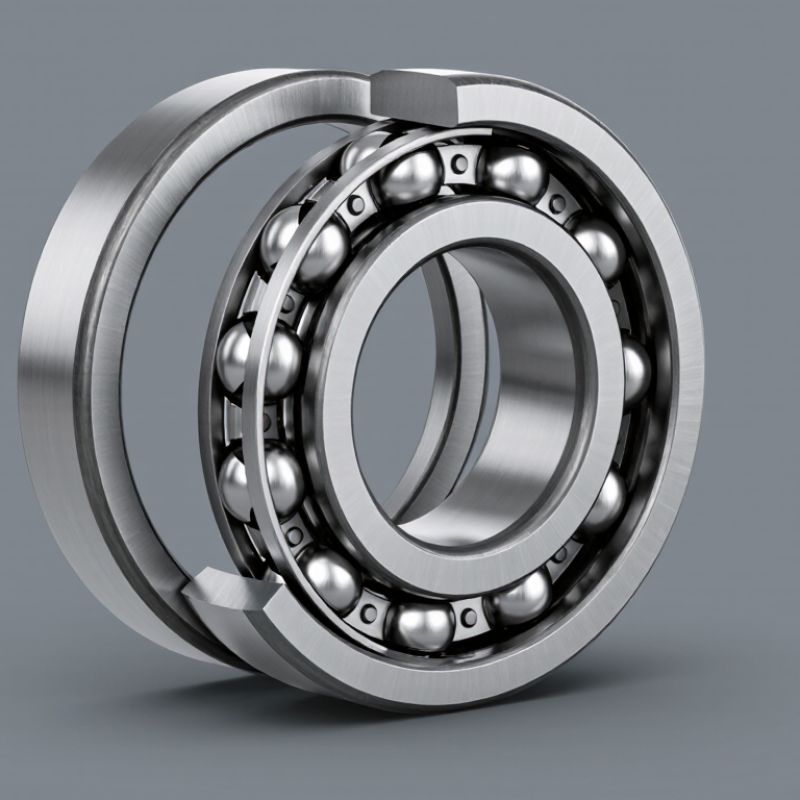
A double row ball bearing places two parallel rows of balls inside one compact raceway system. Each row follows its own circular ball path, sharing the inner and outer rings. This arrangement supports radial loads and moderate axial loads in both directions. It also provides greater stiffness than a single-row bearing of similar outside diameter. Two paths. More support.
As the shaft rotates, balls roll between hardened raceway surfaces with minimal sliding. The contact angle determines how effectively the bearing handles side loads. Greater angles usually improve axial capacity, while smaller angles favor radial loading. The two rows distribute force across a wider area, reducing local stress on the rings. However, load sharing is rarely perfectly equal. Slight shaft bending, housing distortion, or uneven clearance can shift force toward one row.
In practical maintenance, correct fits and clean lubricant matter as much as bearing size. A loose fit may allow creep, while excessive interference can create damaging heat. Contamination is especially harmful because one small particle can mark both raceway paths. Technicians should check noise, temperature, vibration, and seal condition during operation. I would not treat “compact” as “maintenance-free.” The design saves space, but alignment and lubrication still demand careful judgment.
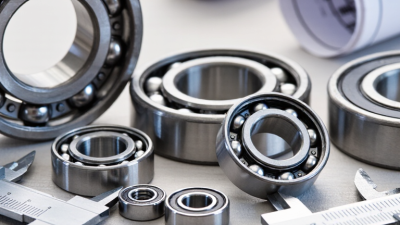
A double row ball bearing places two rows of balls inside one bearing assembly. This arrangement supports radial loads and limited axial loads while occupying less space than two separate bearings. Deep-groove designs use continuous raceways. They suit electric motors, conveyors, and general machinery with changing loads. Their geometry is simple, but contamination can quickly damage the polished raceways.
Angular-contact configurations place the raceways at an intentional contact angle. They handle combined radial and axial forces, especially where shaft positioning matters. Increasing the contact angle usually improves axial capacity, but may raise friction and heat. Self-aligning configurations use a spherical outer raceway. They tolerate shaft deflection or housing misalignment better. They cannot correct poor installation indefinitely. That distinction is often missed.
ISO 281 defines basic rating life as the revolutions reached by 90% of identical bearings under stated conditions. Real service life can differ sharply because lubrication, seals, vibration, and cleanliness remain influential. The U.S. Department of Energy’s motor-system sourcebook reports that motor systems consume about 68% of industrial electricity in U.S. manufacturing. Small friction losses therefore deserve attention. A 0.01-millimeter alignment error may matter more than a larger theoretical load margin. Selection is rarely perfect on the first attempt. Field temperature readings, noise checks, and relubrication records should challenge the original calculation.
What Is a Double Row Ball Bearing and How Does It Work?
A double row ball bearing contains two parallel rows of balls inside one inner and outer ring. Each row creates a separate rolling path, so the bearing can support radial loads from several directions. The two rows also resist axial loads, especially when the raceway geometry creates angular contact. In service, the load does not always divide evenly. Shaft deflection, housing distortion, clearance, and uneven lubrication can push more force onto one row.
Think of a conveyor pulley carrying a heavy, rotating drum. The radial load presses the shaft downward, while belt tension can create axial movement or tilting. Both ball rows react through elastic contact with the raceways. Their contact angles guide the force through the bearing, limiting sliding and maintaining rotation. Misalignment still causes trouble. A small installation error can create edge stress, heat, and premature wear.
ISO 281:2007 defines basic rating life using a 90% reliability benchmark. This means 90% of identical bearings are expected to reach the calculated life under stated conditions. ISO 76:2006 separately evaluates static load capacity and permanent deformation risk. These figures are useful, but they are not promises. Real service includes dirt, poor seals, interrupted lubrication, and shock loads. Engineers should verify both rows under actual operating conditions, not assume perfect load sharing. The assumption is convenient, and sometimes wrong.
| Data Dimension | Technical Description | How the Two Rows Share the Load | Service Effect |
|---|---|---|---|
| Basic construction | Two parallel rows of rolling balls run between common inner- and outer-ring raceways. | Both rows contact the raceways and participate in transmitting forces between the shaft and housing. | The bearing can carry more load and resist tilting moments more effectively than a comparable single-row arrangement. |
| Radial load path | A radial load acts perpendicular to the shaft axis and is transferred through the loaded balls into the raceways. | Under centered, symmetrical loading, the two rows may carry approximately comparable portions of the radial load. Actual sharing changes with clearance, deflection, manufacturing tolerances, and load position. | The effective radial load capacity is higher than that of one row, provided the load is distributed correctly and the rings are properly supported. |
| Axial load path | An axial load acts parallel to the shaft axis and is carried through the ball-to-raceway contact geometry. | In double-row deep-groove designs, both rows can support axial load in either direction. In double-row angular-contact designs, the row arrangement determines the permitted axial-load directions. | Axial capacity and stiffness depend strongly on the internal design, contact angle, preload or clearance, and the direction of the applied force. |
| Combined radial and axial loading | Many applications apply radial and axial forces at the same time, such as belt drives, gearboxes, wheels, and pumps. | The radial component primarily loads the rows through their radial contact zones, while the axial component changes the contact forces and may shift the load toward one row. | Bearing selection must use the combined-load rating method specified for the particular bearing design rather than adding radial and axial ratings directly. |
| Moment and overturning resistance | A tilting moment creates different reaction forces across the bearing width. | The axial spacing between the two rows provides a wider reaction base, allowing one row to carry increased load while the opposite row carries a balancing reaction. | Improved moment stiffness can help control shaft deflection, but excessive moment loading can overload one row and shorten fatigue life. |
| Load distribution between rows | The load is not automatically divided equally during all operating conditions. | Unequal sharing can result from shaft or housing misalignment, uneven fits, ring deformation, axial displacement, internal clearance, and external moments. | Correct housing geometry, shaft alignment, fits, and support stiffness are essential for using the capacity of both rows effectively. |
| Misalignment capability | Most double-row bearings have less freedom to accommodate misalignment than self-aligning bearing designs. | Angular misalignment can concentrate contact in one row or at one edge of the raceway instead of distributing the load evenly. | Where housing or shaft misalignment is expected, a self-aligning configuration or a suitable external alignment solution may be required. |
| Speed and friction | Two rows generally mean more rolling contacts, more internal components, and greater friction than a similar single-row bearing. | Both rows contribute to torque and heat generation while sharing the applied load. | The allowable speed may be lower than for a comparable single-row bearing, so lubrication, cooling, and speed ratings must be checked. |
| Lubrication requirement | Rolling contacts, raceways, cages, and seals require an adequate lubricant film. | Each row must receive sufficient lubricant; poor distribution can cause one row to run hotter or wear faster than the other. | Correct grease quantity, oil flow, viscosity, relubrication interval, and operating temperature are important for service life. |
| Design selection checks | Key factors include bore and outside diameter, load magnitude and direction, speed, temperature, stiffness, life requirement, sealing, and mounting conditions. | The selected design must keep the contact stresses, internal clearance, and row load distribution within acceptable limits under the complete operating load spectrum. | A double-row bearing is appropriate when compact radial and axial support or higher moment resistance is needed, but it is not automatically the best choice for every application. |
Note: Actual load capacity, allowable speed, axial-load direction, and row-by-row load distribution depend on the specific bearing configuration and operating conditions.
A double-row ball bearing contains two parallel rows of balls within one inner and outer ring. This arrangement supports radial loads and moderate axial loads from both directions. It can also improve rigidity where space is limited. In practice, I have seen uneven housing seats create unequal load sharing. Clearance and alignment still matter.
ISO 281 estimates bearing fatigue life through C, P, and the exponent p. C is the basic dynamic load rating, expressed in newtons or kilonewtons. P is the equivalent dynamic bearing load under actual operating conditions. For ball bearings, p equals 3. The basic rating life is calculated as L10 = (C/P)^3 million revolutions. L10 represents the life that 90% of identical bearings may reach.
A useful check.
Suppose C is 10 kN and P is 2 kN. The calculation becomes (10/2)^3, or 125 million revolutions. At 1,500 revolutions per minute, this equals about 1,389 operating hours. This number can look precise, perhaps too precise. ISO 281 does not fully capture poor lubrication, dust, vibration, electrical damage, or severe misalignment. Those conditions can shorten actual service life sharply. Engineers should verify the load spectrum, speed, lubrication method, and mounting quality before accepting the result. The equation is valuable, but it is not a promise.
A double-row ball bearing uses two rows of balls in one housing. This arrangement supports radial loads and limited axial loads in both directions. It also resists tilting better than a single-row bearing. However, capacity depends on load distribution between the rows, not simply on twice the ball count.
ISO 76:2006 defines the basic static load rating, C0, using a reference contact stress of 4,600 MPa and a permanent deformation limit near 0.0001 times the ball diameter. Engineers compare C0 with the static equivalent load, P0, using s0 = C0/P0.
A higher safety factor helps with shock loads, but it cannot correct poor alignment. Deformation may begin at a small contact mark. That mark can later create noise and vibration. ISO 281:2007 also reminds engineers that fatigue life and static capacity are different checks.
Sealing and lubrication need separate attention. A sealed bearing may reduce contamination risk, yet seals can increase friction and heat. Grease selection should match speed, temperature, and load. Too much grease can churn inside the bearing. Too little can expose the raceway.
Tips: Check C0, P0, and s0 under the worst load combination. Measure housing fits and shaft runout during installation. Recheck lubrication intervals in dusty or wet service. These checks are practical, but not perfect; real misalignment can exceed the assumptions used in catalog calculations.
Copyright © 2023 NEI Ltd. All rights reserved.
Registered Office : 9/1, R. N. Mukherjee Road, Kolkata – 700 001. In case of any queries or grievances, please contact Mr.Tarun Kumar Kabra, Company Secretary.
E-mail: sale@kinpart.com Privacy Policy Cookie Policy