How to Choose the Right Switching Power Supply for Your Needs?
Choosing the right Switching Power Supply can seem daunting. However, understanding your specific requirements can simplify the process. Dr. Alice Wang, a notable expert in power electronics, once stated, "A tailored Switching Power Supply is the backbone of any reliable electronic design." Her insight emphasizes the importance of matching supply characteristics to your project needs.
Various factors influence the selection of a Switching Power Supply. Consider output voltage, current capacity, and efficiency ratings. Many overlook the impact of size and thermal management. A unit that’s too large might complicate your design. Conversely, an underpowered supply can lead to failures and frustration. Each detail matters in the design.
Reflecting on the options can reveal that a "one-size-fits-all" approach rarely works. Each application is unique, and so are the power requirements. A careful evaluation can help avoid costly mistakes. Don't rush the decision. Instead, take time to analyze your needs and the available choices.
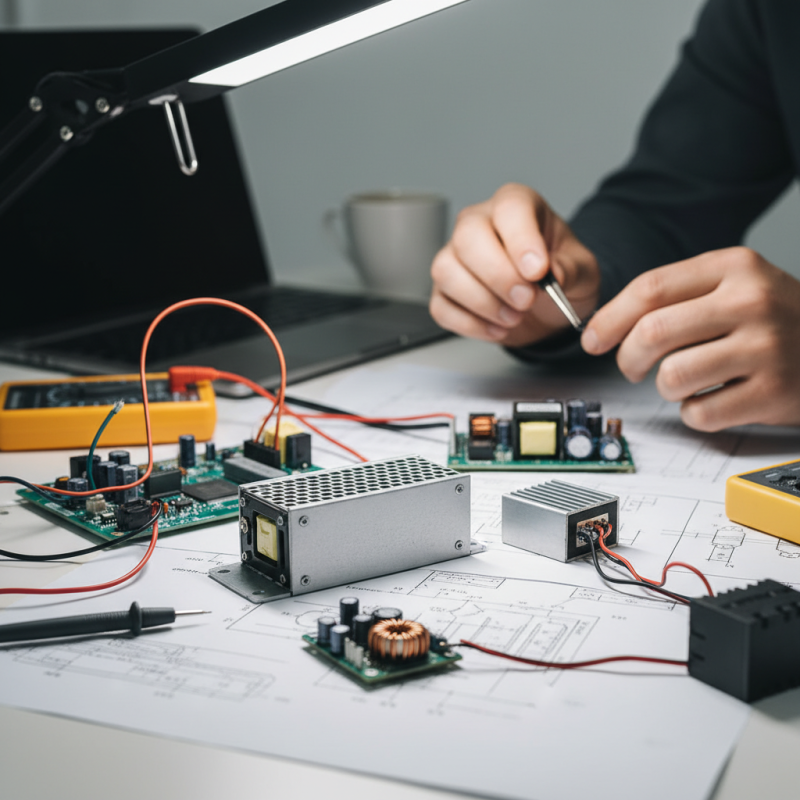
Understanding the Basics of Switching Power Supplies
When selecting a switching power supply, understanding the fundamentals is crucial. A switching power supply converts electrical power efficiently. Unlike linear power supplies, they use high-frequency switching. This method minimizes heat generation, making them ideal for various applications. You'll often find them in computers and consumer electronics. They come in different types and voltage levels, which can be confusing.
Consider your system's voltage requirements. Many devices need specific voltages for optimal performance. Moreover, pay attention to the power rating. It should exceed your device's maximum power draw. If you choose a supply that is too low, it can cause instability. On the other hand, an oversized unit might lead to inefficiencies. Additionally, these power supplies often have a wide input voltage range. However, not all models provide the same level of reliability.
Evaluate form factor and noise levels as well. Sometimes, a compact design may look attractive. Yet, it could sacrifice performance or generate excess noise. Aim for balance in size, performance, and cost. Most importantly, think about long-term needs. What works now might not suit future specifications. Choosing wisely requires careful consideration and potential readjustments down the line.
Identifying Your Power Requirements and Specifications
When selecting a switching power supply, understanding your power requirements is crucial. Start by determining the total wattage needed for your devices. Consider each component's voltage and current specifications. For instance, a device rated at 12V and 2A requires 24 watts. If you have multiple devices, add up their demands. This will help you pinpoint the necessary wattage for your power supply.
Another important factor is efficiency. An efficient power supply reduces energy waste and heat generation. Look for units with high efficiency ratings. A unit that operates at over 80% efficiency is generally a good choice. Consider the environment too. Ensure that your power supply can function within the temperature range of your setup.
Think about the connections you need. Some supplies come with fixed connectors, while others offer modularity. This affects installation and cable management. You might not get it right the first time. Testing different setups can help refine your choices. Ultimately, a thoughtful approach will lead to a better fit for your needs.
Evaluating Efficiency Ratings and Performance Metrics
When selecting a switching power supply, efficiency ratings are crucial. A higher efficiency translates to less wasted energy. Look for models that offer at least 80% efficiency. It's not just a number; it directly impacts your energy bills. Some power supplies may boast high efficiency but underperform in real-world applications. Check for measurements in different load conditions.
Performance metrics matter too. Evaluate the load regulation and ripple voltage. A good power supply maintains stable output despite fluctuations. Excess ripple can harm sensitive electronics. Assess how it performs under varying loads. If a supply can't handle the demand smoothly, consider alternatives. Reading consumer reviews can also uncover performance truths that specs alone won't reveal.
Finding the right balance between efficiency and performance may take time. Sometimes, the less expensive option presents hidden issues that affect long-term reliability. Aim for a power supply that meets your specific needs, even if it requires some trial and error.
How to Choose the Right Switching Power Supply for Your Needs? - Evaluating Efficiency Ratings and Performance Metrics
| Power Rating (W) | Input Voltage (V) | Output Voltage (V) | Efficiency (%) | Load Regulation (%) | Ripple & Noise (mV) |
| 50 | 100-240 | 5 | 85 | ±5 | 50 |
| 75 | 100-240 | 12 | 88 | ±3 | 30 |
| 100 | 100-240 | 15 | 90 | ±2 | 20 |
| 150 | 100-240 | 24 | 92 | ±1.5 | 15 |
| 200 | 100-240 | 36 | 94 | ±1 | 10 |
Analyzing Size, Form Factor, and Cooling Considerations
Choosing the right switching power supply involves careful analysis of size, form factor, and cooling considerations. The size of the power supply can significantly affect its fit within your project or device. A report from the International Electrotechnical Commission states that about 40% of power supply issues stem from improper sizing. A compact supply may save space but can compromise heat dissipation.
Form factor also plays a crucial role. Power supplies come in various shapes and configurations. The dimensions and layout can impact mounting options and the overall design of the system. For instance, a standard ATX power supply might not be suitable for compact applications. A study by Power Electronics Research indicates that 30% of design failures originate from neglected form factor considerations.
Cooling is another vital aspect. Switching power supplies generate heat, which can affect performance. Reports show that inadequate cooling can reduce efficiency by up to 20%. Ensuring proper airflow and using heatsinks can maximize lifespan. It's essential to balance size with cooling solutions. Larger cooling systems can enhance performance but take up valuable space. Designers must reflect on trade-offs to achieve optimal performance.
Assessing Safety Features and Compliance Standards
When selecting a switching power supply, safety features and compliance standards are crucial. A reliable power supply must adhere to international safety standards like IEC 60950 and UL 60950. These standards ensure that the device is safe for both users and equipment. According to a recent study by the International Electrotechnical Commission, around 30% of electrical accidents occur due to non-compliant power supplies. This highlights the importance of compliance.
Moreover, consider safety features such as over-voltage protection and thermal management. These features prevent damage during unexpected conditions. For instance, over-voltage protection can save both the power supply and the connected devices from electrical surges. In 2022, the IEEE reported that incidents involving overheating power supplies accounted for nearly 25% of system failures. These failures are not just costly; they pose significant safety risks.
Many power supplies do offer safety features, but not all are equally effective. Users often overlook the need for detailed specifications, leading to suboptimal choices. For example, a unit may comply with basic safety guidelines but lack robust thermal management. This could result in potential hazards. Thus, it is essential to go beyond superficial compliance checks and evaluate the effectiveness of the power supply’s safety features. Reassessing these can lead to better decisions and safer operations.