

nbc logo (2)
Office address
National Engineering Industries Ltd.
Khatipura Road Jaipur – 302006 Rajasthan, India
Phone Number

Toll Free: 1800 3000 6222
Telephone: +91 141 222 3221
Fax: +91 141 222 1926, 222 2259
CIN: U29130WB1946PLC013643

How to Choose the Best Weigh Feeder in 2026?

Choosing the right Weigh Feeder in 2026 means looking beyond catalogue accuracy. A feeder must deliver a steady rate when the material changes, the hopper level falls, or dust coats the belt. Small errors matter. They can shift product quality, create giveaway, or interrupt a production line.

The market context is expanding, but broad figures need careful interpretation. Grand View Research estimated the global conveyor systems market at USD 7.9 billion in 2023 and projected growth through 2030. That category includes many systems, not weigh feeders alone. Still, it signals why buyers should assess integration, service support, and measurement performance—not just purchase price. CEMA’s *Belt Conveyors for Bulk Materials* is also a useful technical reference for understanding belt behavior and material handling.

Measurement matters. W. Edwards Deming’s reminder, “In God we trust; all others must bring data,” fits feeder selection well. It is not a weigh-feeder specification, but it captures a sound buying principle: request test results, calibration records, and performance data under conditions resembling your process. Check how the unit handles your actual material, including its flowability, particle size, and moisture. Ask how quickly it responds to setpoint changes, and what happens during startup or belt buildup.

There is no universal best model. A compact feeder may suit a clean, steady powder, while abrasive granules can demand different belt, drive, and enclosure choices. And specifications can look reassuring on paper. This guide will help compare accuracy, capacity, controls, maintenance access, and lifecycle cost—so your shortlist reflects the plant, not just the brochure.
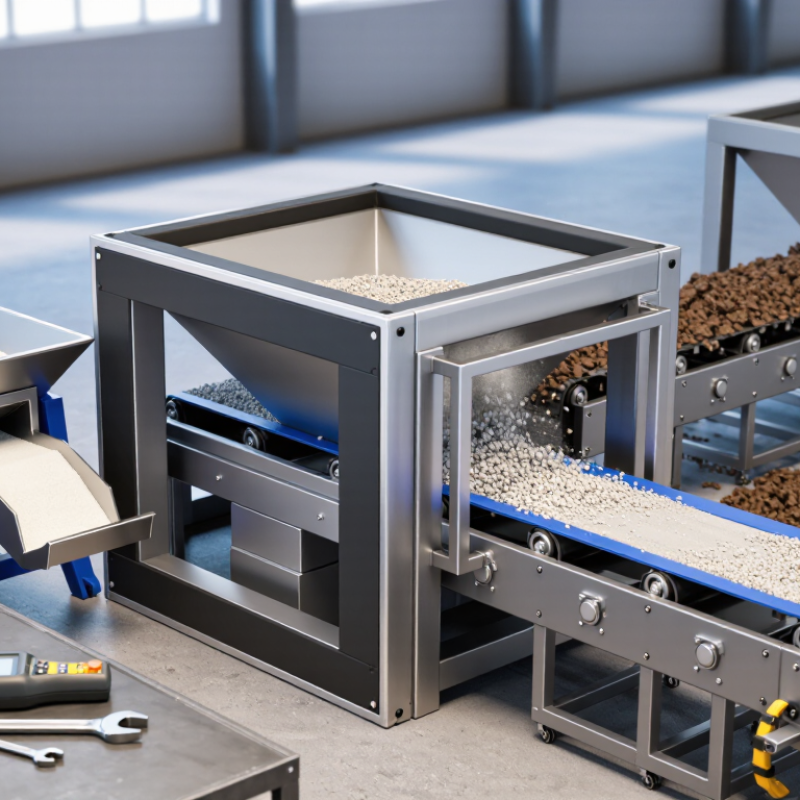
How to Choose the Best Weigh Feeder in 2026?

Identify Feeder Type: Belt, Screw, Vibratory, or Loss-in-Weight

Choosing a weigh feeder starts with the material, not the machine. Belt feeders suit steady flows of granules or larger solids, especially when a visible, accessible feed path helps operators spot buildup. NIST Handbook 44, Section 2.21, identifies belt-conveyor scale accuracy classes of 0.25%, 0.5%, and 1.0%. These are standards-based classifications, not guarantees of installed performance. Belt tension, dust, and uneven loading still matter.

Screw feeders enclose the material and work well with powders or compact layouts. Yet sticky powders can cling to flights, while poor hopper design can cause bridging. Vibratory feeders offer gentle handling for fragile particles and short, controlled transfers. They may struggle when material properties shift or nearby equipment causes vibration. Small details matter. A few minutes watching a test run can reveal surging that a datasheet will not.

Loss-in-weight feeders measure the reduction in hopper mass and adjust output to maintain a set rate. They are often a strong choice for precise, continuous dosing, but refill periods and material flowability need attention. Before selecting, compare required throughput, accuracy, particle size, and cleaning access. Ask suppliers to test your actual material and record the operating conditions. The uncomfortable truth: no feeder type fixes an unstable process by itself. NIST’s classification gives a useful reference point; real performance still depends on installation and routine calibration.
Characterize Bulk Density, Particle Size, Moisture, and Flowability

A weigh feeder can only control what it can consistently draw. Start by measuring bulk density at the material’s expected low and high levels; ASTM D7481 provides methods for loose and tapped powder density. Record particle-size distribution, not just the average. A few oversized granules can interrupt discharge, while fine particles may compact and bridge. Moisture matters too: FAO grain-storage guidance commonly cites 13–14% moisture for safe cereal storage, but that is not a universal feeder setting. Even a small moisture shift can change flow and density. Test the material as delivered, not only in a clean laboratory sample. That assumption is easy to miss.

Tips: Keep a sealed sample from each supplier lot. Check moisture and bulk density before commissioning, then repeat when feed rates drift.

Finally, assess flowability under realistic hopper conditions. Note whether the material forms a stable arch, leaves ratholes, or surges after standing. These observations help determine whether a screw, belt, or vibratory feeder suits the application. Then run trials at minimum and maximum throughput, using the actual particle mix and moisture range. Compare feeder readings with collected weights over timed intervals. A dry bench test may look perfect; production may not. Recheck after cleaning or seasonal changes, since surface moisture and fines can alter discharge. Keep the test record, including sample source, temperature, and conditioning time, so later adjustments have evidence behind them.

Size the Feeder for Minimum and Peak Required Feed Rates

Size the feeder against the actual operating range, not just the nameplate peak. Record minimum and maximum feed rates, then convert both to volumetric flow using measured bulk density. For example, a line requiring 0.8–12 tonnes per hour of material at 0.8 tonnes per cubic metre needs roughly 1–15 cubic metres per hour. That is a 15:1 turndown. Small rates matter. At the low end, a thick bed may pulse instead of feeding smoothly; at peak, the same belt may run out of loading space. CEMA’s Belt Conveyors for Bulk Materials, 7th edition, provides design guidance on belt loading and material characteristics, both relevant to this check.

Do not assume one density value covers every shift. Aeration, moisture, and particle-size changes can alter the volume occupying the belt. Test representative material, then confirm the feeder’s stable minimum rate and maximum capacity under process conditions. NIST Handbook 44 (2025 edition) lists belt-conveyor scale accuracy classes from 0.25% to 2%; these are scale classifications, not a feeder-sizing guarantee. Use them as a reminder to define how performance will be verified, rather than as a substitute for a capacity test. A spreadsheet may still miss a sticky corner case. Leave operating margin, but document why it is needed.

Check Belt-Weigher Accuracy Classes 0.2, 0.5, 1, and 2 Under OIML R 50

Choosing a belt weigher in 2026 starts with understanding its accuracy class under OIML R 50. The classes 0.2, 0.5, 1, and 2 indicate progressively wider permissible error limits in prescribed tests. A lower class number means tighter limits, not a guarantee of identical accuracy in every installation. Check the instrument’s approval documents and the conditions used for testing.

Class 0.2 may suit demanding custody-transfer or process-control duties, where small measurement differences matter. Class 0.5 is often a practical choice for controlled, steady material flows. Classes 1 and 2 can fit less exacting duties, but confirm the permitted error against your operating needs. Small errors add up. For example, changes in belt loading, speed, material buildup, or tracking can affect readings even when the instrument meets its stated class.

Look beyond the class label. Ask how the feeder performs across your actual flow range, and whether the test conditions reflect your belt, material, and environment. Inspect load-cell mounting, belt tension, alignment, and zero stability during commissioning. Keep calibration and verification records, and investigate drift rather than assuming it is normal. Real installations are imperfect. A carefully maintained class 1 system may serve better than a poorly installed class 0.2 unit, though that trade-off deserves review against the required measurement tolerance.

Evaluate Controls, Calibration, Safety, and Maintenance Requirements

Choosing a weigh feeder starts with its job: steady dosing, frequent recipe changes, or handling material that bridges easily. Controls should make setpoint changes clear and show rate, total, alarms, and manual mode without burying operators in screens. Small details matter. Check how the feeder responds when material flow surges or the line pauses; a smooth display does not guarantee stable delivery. Ask whether control signals can be checked against an independent reference during commissioning.

Calibration needs a documented method, accessible test weights or other approved references, and enough clearance for safe checks. Record zero and span results, test conditions, and adjustments. Repeat checks after belt replacement, impact, or major cleaning. No setup stays perfect. Safety features should include accessible emergency stops, guarded moving parts, and safe isolation points for service. Verify these in the actual installation, not just on a drawing. Maintenance also depends on dust buildup, belt tracking, load-cell access, and spare-part lead times. Walk the service route with a technician. If routine cleaning requires awkward reaching, the design may look efficient on paper but lose time on shift. That trade-off deserves a second look.

How to Choose the Best Weigh Feeder in 2026? - Evaluate Controls, Calibration, Safety, and Maintenance Requirements

Evaluation Factor What to Check Belt Weigh Feeder Loss-in-Weight Screw Feeder Vibratory Weigh Feeder
Best-Fit Materials Consider particle size, flowability, bulk density, abrasiveness, moisture, and tendency to bridge or segregate. Often suitable for granules, pellets, and other materials that form a consistent bed on a belt. Often used for powders and small granules; screw and hopper design must match the material’s flow behavior. Often suitable for free-flowing powders, granules, and fragile products where gentle handling is important.
Feed-Rate Control Verify the required minimum and maximum rate, response time, rate stability, and integration with the plant control system. Typically regulates feed by adjusting belt speed; stable loading and belt tracking affect performance. Regulates feed using screw speed and measured loss of hopper weight; refill periods require suitable control logic. Regulates feed by changing vibration amplitude or frequency, depending on the feeder design and controller.
Controls and Integration Check local and remote setpoint control, rate display, alarms, data access, communications, and fail-safe behavior. Confirm the controller can use belt-load and speed signals and provide clear belt-motion and rate alarms. Confirm the controller supports weighing during feeding, refill handling, and stable transition back to gravimetric operation. Confirm the controller provides repeatable vibration adjustment and suitable interlocks for the process.
Calibration and Verification Review zero and span procedures, test-weight or material-test provisions, calibration access, and the required verification schedule. Check belt-scale zeroing, test-weight provisions where applicable, and material tests to verify delivered mass flow. Check load-cell zero and span procedures, hopper tare, and gravimetric rate verification under operating conditions. Check weighing-system zero and span procedures and verify delivered mass over a timed collection test.
Installation Conditions Assess available space, mounting stiffness, vibration, dust control, access for inspection, and upstream or downstream equipment. Needs suitable belt support and alignment; external vibration or material buildup can affect weighing stability. Needs a stable, isolated weighing structure and flexible connections that do not impose unwanted forces on the hopper. Needs a stable mounting arrangement; surrounding vibration and rigid connections can influence weighing readings.
Safety Requirements Identify guarding, emergency stops, electrical protection, dust hazards, access requirements, and applicable site rules. Guard accessible moving belts and pinch points; provide safe isolation before clearing or servicing the conveyor. Guard rotating screws and drives; use lockout procedures before opening or clearing the feeder. Protect operators from moving or vibrating components and isolate power before maintenance or cleaning.
Maintenance and Cleaning Compare routine inspection tasks, wear parts, cleaning method, spare-parts availability, and expected service access. Inspect belt condition, tracking, tension, idlers, and material buildup; access should allow safe cleaning. Inspect screw, bearings, seals, and drive components; consider how the design handles buildup and product changeovers. Inspect the tray, springs, drive, and fasteners; confirm cleaning access and compatibility with the required washdown method.
Selection Decision Ask suppliers to demonstrate performance using representative material and agreed operating conditions. Consider when a continuous belt-based feed and accessible conveyor arrangement suit the process. Consider when gravimetric feeding from a weighed hopper and enclosed screw delivery fit the material and process. Consider when gentle handling and controlled vibration suit the product and required feed behavior.

Note: Feeder suitability and achievable performance depend on material properties, equipment design, installation, and operating conditions. Confirm requirements through application-specific testing and supplier documentation.

Article Source: