How to Choose the Best Polyester Film Capacitors for Your Needs?
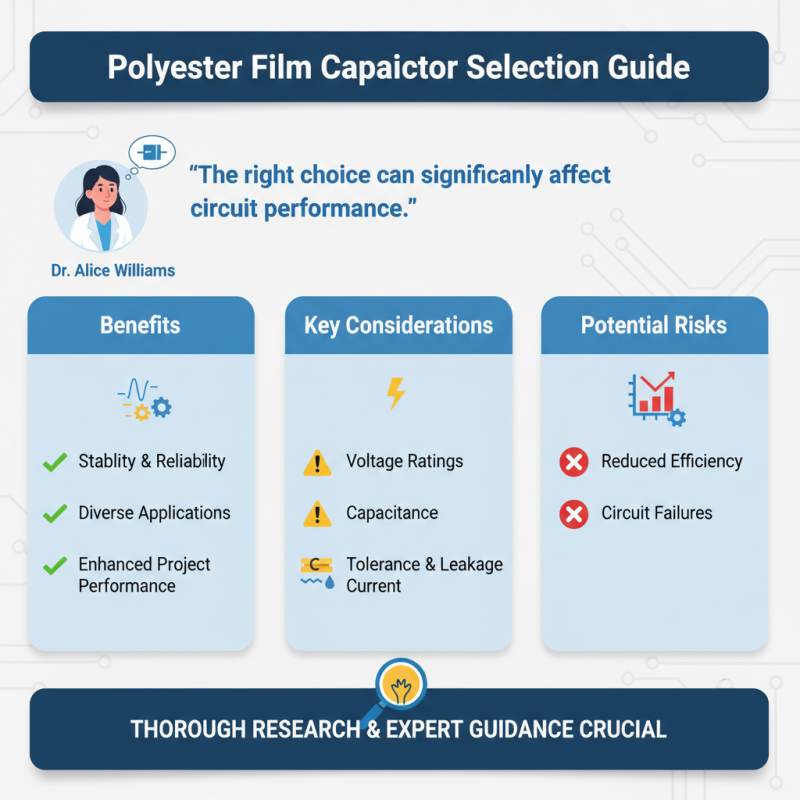
When it comes to selecting the ideal Polyester Film Capacitors, expertise is essential. Dr. Alice Williams, a leading figure in capacitor technology, once said, "The right choice in capacitors can significantly affect circuit performance." This statement highlights the importance of careful consideration in your selection process.
Polyester film capacitors offer a range of features. Their stability and reliability make them suitable for various applications. However, choosing the wrong type can result in reduced efficiency. You need to understand specifications like voltage ratings and capacitance. This ensures alignment with your specific needs.
While the right decision can enhance your project, it can be overwhelming. Not all polyester film capacitors are created equal. Variations exist in size, tolerance, and leakage current. A wrong choice may lead to circuit failures. Therefore, thorough research and expert guidance are crucial in making an informed decision.
Understanding Polyester Film Capacitors and Their Applications
Polyester film capacitors are crucial components in modern electronics. They excel in applications requiring stability and reliability. These capacitors offer low leakage current, making them suitable for various devices. They are commonly used in power supplies, audio applications, and timing circuits. The ability to perform well at different temperatures is essential for many industries.
When choosing polyester film capacitors, consider their capacitance values and voltage ratings. It's important to reflect on the specific needs of your project. Not all polyester films are created equal. Some may have better tolerance levels, while others are more suited for high-frequency applications. Understanding the differences among types can prevent future issues, such as overheating or premature failure.
Selecting the right polyester film capacitor may seem straightforward, but challenges arise. Some components may not fit well in compact designs. Others may struggle with performance under stress. Testing and evaluating different models is often necessary to make the best choice. Trusting your instincts and gaining experience through trial and error can significantly impact your results.
Key Specifications to Consider When Choosing Polyester Film Capacitors
When selecting polyester film capacitors, several key specifications are essential for optimal performance. Voltage rating is crucial. It defines how much voltage a capacitor can handle safely. A capacitor rated for low voltage may fail under high stress. Data from industry reports show that a capacitor's voltage rating should always be 20% above the maximum circuit voltage.
Another critical specification is capacitance value. This value directly impacts the capacitor's ability to store electrical energy. Typically, capacitance values range from a few nanofarads to several microfarads. The right choice depends on your application. It might seem straightforward, but using an incorrect capacitance value could lead to inefficient circuit performance. Moreover, tolerance is vital too. Capacitors often have differing tolerances, indicating the permissible deviation from the stated capacitance.
Temperature stability is another consideration. Polyester film capacitors offer a diverse range of temperature coefficients. This means their performance may vary with temperature changes. In real-world applications, many users overlook this point. Ignoring temperature specs can hinder device reliability. Understanding these parameters ensures that designers select the right capacitors, enhancing overall efficiency in electronic circuits.
Comparing Different Types of Polyester Film Capacitors
When comparing different types of polyester film capacitors, it’s essential to understand their unique properties. The most common types include metallized polyester, which offers a compact design and greater reliability. This variety is known for its self-healing ability, making it a dependable choice for many applications. Non-metallized types, on the other hand, are often larger and can handle higher voltage levels. They may be suitable for specific setups where size is less of a concern.
The choice may come down to application needs. For high-frequency environments, metallized variations typically perform better. However, they can sometimes struggle with higher voltage levels. Conversely, non-metallized capacitors, while bulkier, can endure more extreme electrical conditions. It can be tricky to strike a balance between size and performance.
Moreover, consider the capacitor's tolerance and temperature rating. These specifications affect longevity. Misjudging these factors can lead to equipment failure. Not every option suits every project. Exploring these differences in depth will aid in making an informed decision.
How to Choose the Best Polyester Film Capacitors for Your Needs? - Comparing Different Types of Polyester Film Capacitors
| Capacitor Type | Voltage Rating (V) | Capacitance Value (µF) | Tolerance (%) | Temperature Coefficient (ppm/°C) | Applications |
| General Purpose Polyester | 250 | 10 | ±10 | +/- 100 | Signal Coupling, Decoupling |
| High Voltage Polyester | 630 | 1 | ±5 | +/- 75 | Power Supply, Inverter |
| Low ESR Polyester | 400 | 2.2 | ±10 | +/- 100 | Audio Applications, Filter Circuits |
| Specialty Polyester | 250 | 4.7 | ±15 | +/- 50 | Timing Circuits, Oscillators |
Evaluating the Performance and Reliability of Polyester Film Capacitors
When evaluating polyester film capacitors, it's essential to focus on performance. These capacitors are known for their stability under varying temperatures and voltages. Their ability to maintain capacitance makes them ideal for audio applications, power electronics, and filtering tasks. However, not all polyester capacitors are created equal. Some may experience capacitance loss over time, which can impact circuit performance.
Reliability is another crucial factor. The lifespan of polyester film capacitors is generally long, but environmental conditions can affect their durability. Humidity, for instance, might lead to premature failure. It's vital to review the specifications provided by manufacturers. Considerations such as ripple current rating and voltage rating can significantly influence the capacitor's reliability in real-world applications.
Since there's no one-size-fits-all solution, assessing your specific needs is vital. Sometimes, a capacitor might seem perfect on paper but may not perform well in practice. Testing different configurations in your circuit can provide insights. Stay informed about industry standards and best practices, but remember that even established methods may not guarantee success every time. Reflection on your past choices can guide future decisions.
Tips for Sourcing and Purchasing Quality Polyester Film Capacitors
When sourcing polyester film capacitors, quality is paramount. Start by verifying the specifications. Look for capacitors with a voltage rating that exceeds your application demand. A good rule of thumb is to choose components with at least 20% higher voltage ratings. Research shows that approximately 30% of failures in electronic circuits stem from inadequate capacitor ratings.
Next, consider the capacitance tolerance. Tighter tolerances often ensure better performance. Many reliable capacitors maintain tolerances within ±5% or ±10%. Check for industry certifications, such as ISO 9001, which can indicate a manufacturer’s commitment to quality. Manufacturers with these certifications tend to have more rigorous testing protocols. This can translate to lower failure rates in real-world applications.
Be aware of sourcing challenges. Some suppliers may claim high quality but deliver inconsistent products. Transparency in production processes is essential. Ask for details about source materials and production standards. Not all suppliers are forthcoming, leading you to question their reliability. Conducting thorough due diligence can help you avoid potential pitfalls. Consider leveraging data from industry reports to benchmark suppliers’ performance against peers. Websites like Research and Markets frequently provide insights into market dynamics and supplier analysis.