How to Choose the Right Photoelectric Sensors for Your Needs?
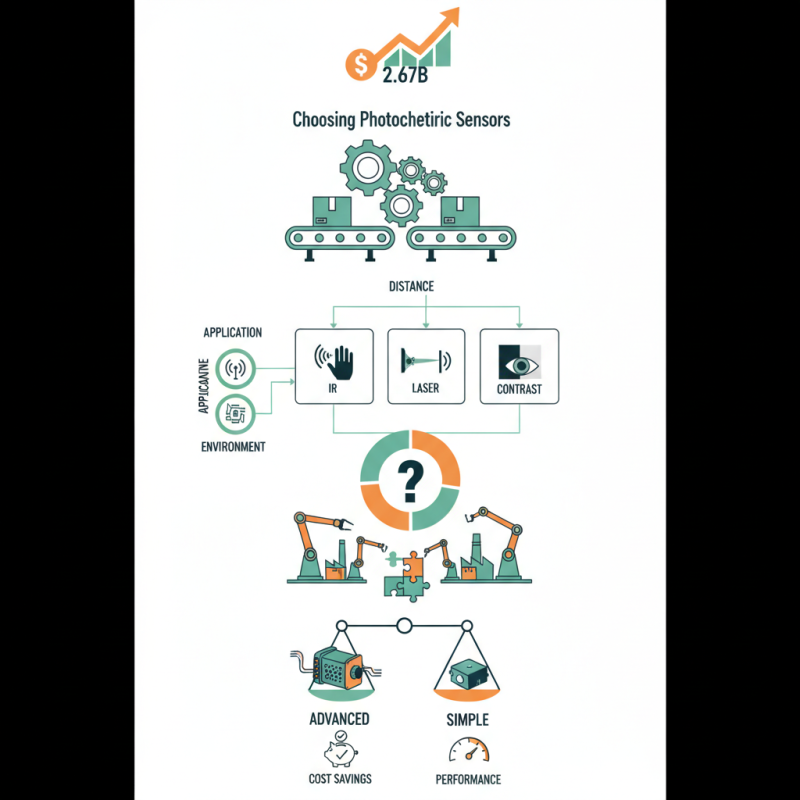
In today’s industrial landscape, selecting the right Photoelectric Sensors is crucial. These sensors play a vital role in automation processes. According to a report by MarketsandMarkets, the photoelectric sensor market is projected to reach $2.67 billion by 2025. This growth highlights the increasing demand for precision and efficiency in manufacturing.
Choosing the appropriate photoelectric sensor depends on various factors, such as the application, distance, and environmental conditions. Each type, whether infrared, laser, or contrast sensors, serves different needs. In a recent survey, 40% of companies cited difficulties in selecting the right sensor for their specific applications. This reveals a gap in knowledge that can impact operational efficiency and safety.
It's essential to understand that not every sensor fits every need. Reflect on the requirements of your application before making a decision. While some sensors offer advanced features, they may not be necessary for simpler tasks. A careful evaluation can lead to better performance and cost savings in the long run.
Understanding Photoelectric Sensors: Types and Applications
Photoelectric sensors are essential devices in many industries. They detect objects and measure distances without physical contact. There are several types of photoelectric sensors, each suited for unique applications. Understanding these types can help you choose the right sensor for your needs.
There are three main types: through-beam, retro-reflective, and diffuse. Through-beam sensors send a beam of light from the transmitter to the receiver. They are ideal for long-range detection. Retro-reflective sensors use a reflector to bounce the light back to the receiver. This type is often used where space is limited. Diffuse sensors can detect objects that reflect light back to their source. They work best for short distances. However, they can be influenced by the color or texture of objects.
While choosing a sensor, consider the environment. Dust, moisture, or vibration can affect performance. Installation may seem simple, but improper setup leads to failures. A reflection on these details can save time and costs. Understanding your specific application requirements is vital for optimal sensor performance.
Key Specifications to Consider When Selecting Photoelectric Sensors
When selecting photoelectric sensors, several key specifications demand careful consideration. One essential factor is the sensing distance. Typical ranges vary from a few millimeters to several meters. Data shows that choosing the wrong distance can lead to frequent sensor failures. For example, a sensor designed for 50 mm may not correctly read objects at 80 mm.
Another critical specification is the type of sensing technology used. There are reflective, diffuse, and through-beam sensors, each with unique applications. Reflective sensors are often easier to install but may have limitations in distorted environments. A report by an industry expert highlighted that 35% of sensor failures occur due to mismatched technology and application. It's crucial to understand the environment where the sensor will operate.
Response time is another specification to weigh. Many applications require quick detection to maintain efficiency. Typical response times can range from a few microseconds to several milliseconds. If the response time does not meet application requirements, it can lead to production delays. However, faster isn’t always better. Careful evaluation of the entire system is needed for optimal performance.
Evaluating the Environment for Optimal Sensor Performance
When choosing photoelectric sensors, the environment plays a crucial role. Different settings can impact a sensor's performance. Consider factors like temperature, humidity, and lighting. For instance, sensors in a wet environment may require special coatings. Dust and dirt can also obstruct the sensor's function.
Examine how outdoor conditions affect your selection. UV exposure can deteriorate sensors over time. Shadows and reflections may cause false readings. In industrial environments, vibrations can lead to sensor misalignment. Sometimes, choosing a robust sensor seems easier. But an over-engineered solution might not be necessary.
Evaluate the space where the sensor will be installed. Adequate space can enhance performance. Mounting height and angle matter too. Proper alignment is vital, yet often overlooked. Installers may not focus enough on real-world factors. It’s important to learn from these mistakes. Observations from previous installations can guide better choices. Recognizing these details can lead to improved sensor reliability.
Comparison of Photoelectric Sensor Types for Different Environments
Comparing Cost-Effectiveness of Different Photoelectric Sensors
Choosing the right photoelectric sensor can significantly impact your project's success. In the realm of automation, cost-effectiveness becomes crucial. Different sensors may vary in price, sensitivity, and detection range. Opting for a less expensive model can save money upfront. However, consider if it meets your specific requirements. Will it perform reliably in your environment?
When comparing sensors, look beyond the initial cost. A higher-priced sensor might offer greater durability and accuracy. For instance, it could provide better performance in dusty or humid conditions. An investment in quality can lead to lower maintenance costs. Think about your long-term needs. Quite often, what seems affordable may not be the best option. Reflect on past choices; a budget model might have led to frequent replacements. Balancing cost with quality is essential.
Each application has unique demands. A sensor that works well in one situation may not suit another. Test multiple options to determine what fits best. Don't overlook the importance of adapting to your specific needs. It's easy to fall into the trap of choosing a popular model without evaluation. Take the time to consider all aspects before making your final decision.
How to Choose the Right Photoelectric Sensors for Your Needs? - Comparing Cost-Effectiveness of Different Photoelectric Sensors
| Sensor Type | Range (mm) | Response Time (ms) | Operating Voltage (V) | Cost ($) | Cost-Effectiveness Rating (out of 10) |
| Through-beam | 300 - 1200 | 1 | 10 - 30 | 150 | 8 |
| Retroreflective | 200 - 800 | 2 | 12 - 24 | 120 | 9 |
| Diffuse Reflective | 100 - 400 | 5 | 10 - 30 | 100 | 7 |
| Photoelectric Switch | 50 - 200 | 10 | 24 - 48 | 80 | 6 |
| Laser Sensor | 100 - 5000 | 0.5 | 5 - 15 | 400 | 10 |
Best Practices for Installation and Maintenance of Photoelectric Sensors
When installing photoelectric sensors, positioning is crucial. Place them at appropriate heights and angles for optimal detection. Ensure the lenses are clean and free from obstructions that could hinder performance. Regularly check the area around the sensors. Dust, dirt, or even spider webs can significantly affect functionality.
Maintenance is just as essential. Inspect wiring and connectors frequently. Loose connections can lead to false readings. Test the sensors periodically to ensure they respond correctly to light changes. It’s not uncommon for sensors to fail after prolonged use. Track their performance and be prepared to adjust settings as needed.
Consider the environment where sensors are placed. Extreme temperatures or moisture can impact their reliability. If issues arise, revisit installation guidelines. Sometimes, a minor adjustment can yield better results. Learning from any mistakes made during the setup is key. Embrace the challenges for continuous improvement.