What Is the Best Three Phase Diesel Generator in 2026?
Choosing the best Three Phase Diesel Generator in 2026 is not a horsepower contest. It is a site-fit decision. A cold warehouse, a rural workshop, and a data center need different starting performance, runtime, and maintenance access. The right set must also match the actual three-phase load, including motors that draw heavy current at startup. Small sizing errors matter.
The International Energy Agency’s Electricity 2025 report says global electricity demand grew by 4.3% in 2024. That figure does not predict generator sales, but it highlights growing pressure on dependable power. Buyers should compare continuous and standby ratings, voltage regulation, fuel consumption at realistic loads, noise, service intervals, and parts availability. Look beyond the brochure’s peak kilowatts. A generator that runs smoothly at 75% load may serve a facility better than a larger unit that spends most of its life lightly loaded.
Fuel deserves scrutiny, too. Diesel-engine pioneer Rudolf Diesel wrote, “Such oils may become in course of time as important as petroleum.” His observation concerned fuel, not modern generator selection. Still, it is a useful reminder: operating assumptions can change. Fuel quality, storage conditions, and approved fuel specifications all affect reliability. No single model wins every site. In this guide, we compare leading options by practical performance and support, while noting where published specifications leave questions unanswered. The best choice is the one that starts reliably, carries your real load, and can be maintained where it operates.
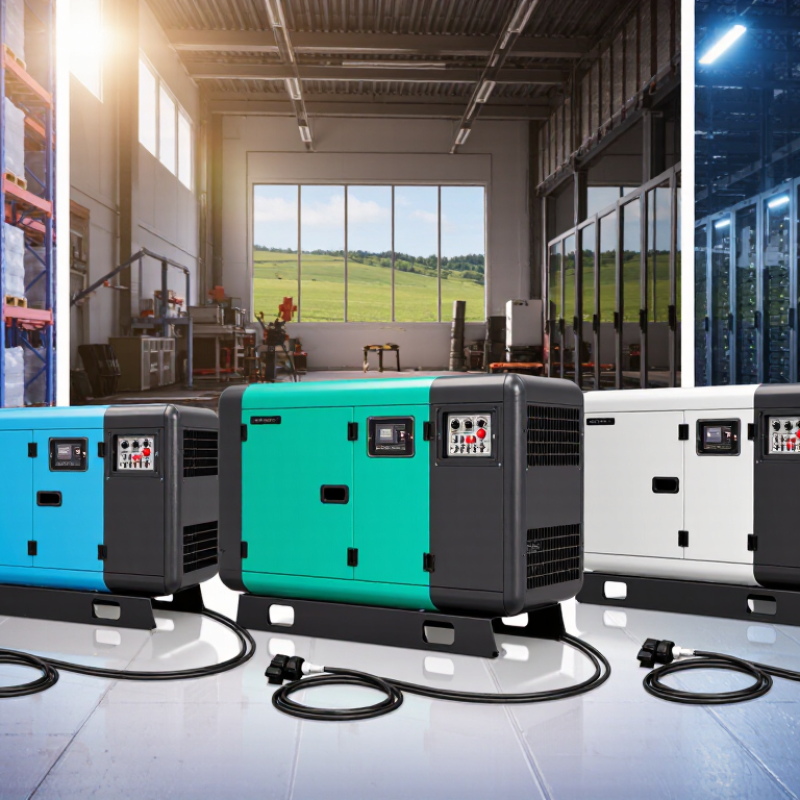
Define “Best” by ISO 8528-1 Ratings: Prime Power vs. Standby Power
The best three-phase diesel generator is not automatically the unit with the largest kilowatt label. ISO 8528-1:2018 distinguishes prime power (PRP) from emergency standby power (ESP). PRP supports variable loads for unlimited annual hours. Its average output over 24 hours is generally limited to 70% of its rating, unless otherwise approved. ESP is intended for emergency use, with operation limited to 200 hours annually under the standard.
That distinction changes equipment selection. A workshop running pumps and compressors for long shifts needs a PRP rating that reflects its changing load. A building backup unit may suit ESP service if outages are brief and infrequent. The U.S. Energy Information Administration reported an average 5.5 hours of power interruptions per customer in 2022, including major events. That figure is useful context, not a sizing guarantee.
Compare ratings on the same basis, then check starting loads, site temperature, altitude, and maintenance requirements. A generator rated only for standby may not tolerate repeated, extended operation as well as a properly selected prime-rated set. I would still question a tidy rule: real outages rarely follow a datasheet’s load profile. Ask for the ISO rating, the permitted annual hours, and the load assumptions behind the quoted kilowatts. Sources: ISO 8528-1:2018; U.S. EIA, 2022 reliability data.
Size the Set with √3 × Voltage × Current × Power Factor
What Is the Best Three Phase Diesel Generator in 2026?
Choose a set by measured load, not headline kilowatts. For balanced three-phase power, kW = √3 × voltage × current × power factor ÷ 1,000. At 400 volts, 100 amps, and 0.8 power factor, the load is about 55.4 kW. That is the demand—not automatically the generator size. Motors can draw much higher current when starting, and hot weather or high altitude can reduce available output. The U.S. Energy Information Administration’s Electric Power Annual reports about 4,178 billion kWh of U.S. net generation in 2023; that grid-wide figure offers context, but cannot replace site measurements.
Tips: Measure each phase under real operating conditions. Check the nameplate voltage and power factor, then list motor-starting loads separately. Ask a qualified technician to verify the calculation and the set’s standby or prime rating. Small details matter. A brief inrush can trip an undersized unit, while excessive oversizing may leave it running inefficiently. I would not trust one peak reading alone; repeat measurements during the busiest operating period. That extra check is easy to skip. It can also prevent a costly mismatch.
Compare Common Three-Phase Systems: 400 V/50 Hz and 480 V/60 Hz
The best three-phase diesel generator depends on the site’s voltage and frequency, not just its kilowatt rating. IEC 60038 specifies 230/400 V as a standard low-voltage system, while ANSI C84.1 covers 480Y/277 V systems in North America. These are not interchangeable settings. A generator must match the connected equipment, protection devices, and distribution system.
Here is a practical comparison. At 100 kW and 0.8 power factor, a three-phase load draws about 180 A at 400 V, or 150 A at 480 V. This calculation uses the standard three-phase power formula; it does not mean the higher-voltage set is automatically more efficient. For four-pole alternators, 50 Hz corresponds to 1,500 rpm, while 60 Hz corresponds to 1,800 rpm. ISO 8528-5 provides performance requirements for generator sets, but the actual operating limits depend on the selected engine and alternator.
For a European-style 400 V, 50 Hz site, check that pumps, motors, and controls are rated for 50 Hz. For a 480 V, 60 Hz facility, verify the same details at 60 Hz. Frequency changes can affect motor speed and driven equipment output. A common oversight is choosing by voltage alone. Even a technically sound comparison can miss cable length, starting current, or future load growth; those details deserve a site-level review.
Check Emissions Rules: U.S. EPA Tier 4 Final and EU Stage V
For a three-phase diesel generator in 2026, emissions compliance starts with the engine category—not the phase count. The U.S. EPA’s 2004 nonroad diesel rule set Tier 4 standards designed to reduce particulate matter by about 90% and nitrogen oxides by about 80% compared with Tier 2 levels. In the EU, Regulation (EU) 2016/1628 establishes Stage V limits, including particle-number requirements for many engine categories. Check the engine’s rated power and intended use; similar-looking generators may fall under different rules.
Ask for the engine-family certificate and emissions documentation before comparing quotes. Tier 4 Final and Stage V systems may use a diesel particulate filter, selective catalytic reduction, or both. These components need suitable fuel, maintenance, and operating conditions. A generator that runs for short periods at light load can present different after-treatment challenges than one serving steady demand. Small detail. It matters.
Also confirm whether the project is treated as stationary or mobile equipment, and check site permits separately. EPA engine certification does not automatically settle every site-level requirement. EU Stage V compliance likewise depends on the engine category and applicable transition provisions. A certificate is useful, but it is not the whole purchasing decision. EPA’s nonroad rulemaking materials and Regulation (EU) 2016/1628 are the primary references; verify the exact engine model and installation with the relevant authority.
EPA Tier 4 Final vs. EU Stage V: Emission Limits
Regulatory limits for non-road diesel engines rated 130–560 kW. Lower limits indicate stricter emission caps.
Both standards set limits of 3.5 g/kWh for CO, 0.19 g/kWh for hydrocarbons, and 0.4 g/kWh for NOx in this power range. EU Stage V sets a lower particulate-mass limit: 0.015 g/kWh versus 0.02 g/kWh under EPA Tier 4 Final, and also includes a particle-number limit. Certification procedures and applicable requirements differ, so emissions compliance alone does not determine which generator is best.
Compare Fuel Use, Load Response, Service Support, and Total Cost of Ownership
The best three-phase diesel generator depends on how it will be used, not just its advertised peak output. Compare fuel consumption at several load levels, such as 25, 50, and 75 percent. A unit that runs efficiently near your normal demand may cost less over time than a larger machine that spends most hours lightly loaded. Ask for test data, not just a single fuel-use figure. Small detail. Tank size also affects refueling frequency and site logistics.
Load response matters when motors, pumps, or compressors start. A pump switching on can briefly pull far more current than it uses while running. Check how quickly the generator restores voltage and frequency after a sudden load change. If possible, test it with the actual equipment and starting sequence. A clean test setup may not reflect a dusty site or an uneven load; that is easy to overlook.
Service support belongs in the cost comparison. Confirm local technician availability, common-part stock, and realistic response times. Then estimate fuel, scheduled maintenance, filters, batteries, transport, and downtime across expected operating hours. Purchase price is only one line in that calculation. I would treat any ownership estimate as provisional: hours, fuel prices, and repair needs rarely follow a perfect forecast.