What Are the Best Industrial Fans Made in China?
Choosing the best Industrial Fans made in China requires more than comparing prices or browsing polished product catalogs. It demands evidence. Factory experience, airflow testing, motor quality, corrosion resistance, and after-sales support all matter. A fan moving 50,000 cubic meters per hour must perform reliably, not merely look impressive on a specification sheet.
Howard D. Goodfellow, a respected industrial ventilation specialist, wrote, “The primary purpose of industrial ventilation is to control airborne contaminants.” That principle remains practical today. Chinese manufacturers produce axial fans, centrifugal fans, explosion-resistant models, and high-temperature units for factories, warehouses, mines, and processing plants. However, buyers should examine test reports, balancing records, impeller materials, bearing systems, and electrical protection ratings. Ask for proof.
Real performance appears on the factory floor. Listen for unusual vibration. Check the welds around the housing. Review whether the stated airflow was measured under pressure, rather than in ideal open conditions. Independent certification can strengthen confidence, but certificates alone do not guarantee a suitable design. Application details still decide the outcome.
This guide will compare leading Chinese Industrial Fans manufacturers through performance, customization, durability, energy efficiency, and service reliability. It will also consider uncomfortable realities. Some product data may be incomplete. Delivery promises can change. Even a reputable supplier may offer the wrong fan for a specific duct system. That is why careful verification matters. The best choice is not always the cheapest, largest, or most powerful model. It is the fan that delivers stable airflow, safe operation, and measurable value in its actual working environment.
Types of Industrial Fans Manufactured in China
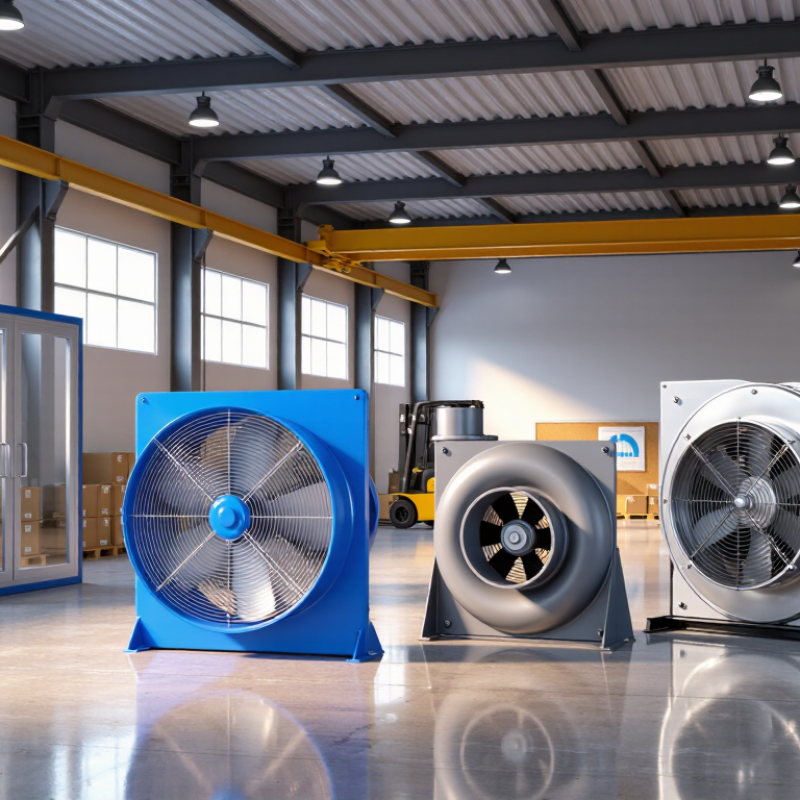
China manufactures a broad range of industrial fans for factories, warehouses, workshops, and agricultural facilities. Axial fans move large air volumes through short, direct paths. They suit general ventilation, cooling lines, and wall-mounted exhaust systems. Centrifugal fans create higher pressure and work well with ducts, filters, and dust collection equipment. Mixed-flow fans balance airflow and pressure in compact systems.
High-volume, low-speed fans are common in large warehouses. Their wide blades move air gently across wide floor areas. Roof exhaust fans remove hot air from production buildings. Portable axial fans help technicians ventilate temporary work zones. Some Chinese manufacturers also produce corrosion-resistant fans for humid environments, using coated steel, stainless steel, or reinforced polymer components. Material selection matters near chemicals or coastal air.
From practical equipment checks, vibration and noise often reveal manufacturing quality. A properly balanced impeller should rotate smoothly without strong cabinet movement. Buyers should request airflow curves, motor data, insulation details, and factory test records. Check the fan at its actual operating pressure, not only at free-air conditions. That mistake is common. Certification documents should match the final model and electrical configuration. Some suppliers offer impressive specifications, but field performance may change after duct installation. Reviewing samples, welds, bearings, guards, and maintenance access can prevent costly surprises. A lower purchase price is not always lower ownership cost. Rescue planning for failures deserves attention too.
What Are the Best Industrial Fans Made in China?
Typical airflow capacity by industrial fan type commonly manufactured in China. The values represent approximate midpoints of commonly specified operating ranges and are provided for general comparison; actual performance depends on fan size, motor power, pressure, and operating conditions.
Airflow is shown in cubic meters per hour (m³/h). Axial and centrifugal fans cover a wide range of industrial ventilation needs, while HVLS fans move very large air volumes at relatively low pressure.
Key Performance Standards for Comparing Chinese Industrial Fans
What Are the Best Industrial Fans Made in China?
Key Performance Standards for Comparing Chinese Industrial Fans
The best industrial fan is not chosen by airflow alone. Compare airflow and static pressure at the same duty point. A fan moving 30,000 cubic meters per hour may fail when duct resistance increases. Request performance data tested under recognized methods, such as AMCA 210 or ISO 5801. The test curve should show efficiency, pressure, speed, and power consumption.
Check the motor carefully. Confirm rated voltage, frequency, insulation class, service factor, and expected operating temperature. In dusty or humid areas, the enclosure rating matters. An IP55 motor may suit general factories, but corrosive or washdown zones need stronger protection. Noise should be measured at a stated distance, not described as “quiet.” Small wording differences can hide major operating problems.
Mechanical stability deserves equal attention. Inspect impeller balance, shaft alignment, bearing design, weld quality, and vibration limits. Ask for balancing records and a factory acceptance test. I once trusted a clean specification sheet too quickly. The installed fan later required more adjustment than expected. That experience changed my process: I now compare measured results, component details, inspection controls, and spare-part availability. Materials also matter. Galvanized steel, stainless steel, and coated alloys perform differently in chemical or coastal environments. A lower purchase price can become expensive through energy use, downtime, and maintenance. Supplier documentation is useful, but independent verification remains necessary.
How to Select the Right Chinese Industrial Fan for Your Facility
Choosing the right Chinese industrial fan starts with your facility, not a product catalog. Measure airflow, static pressure, temperature, dust levels, and available power. A warehouse may need high-volume air movement, while a workshop may require stronger pressure against filters or ducts. Oversized fans waste energy. Undersized fans create hot spots.
Ask suppliers for performance curves tested at your required operating point. Check motor efficiency, impeller balance, bearing quality, vibration limits, and noise levels. For dusty or humid areas, confirm the enclosure rating and material selection. Stainless steel may suit corrosive environments, but coated steel can be more economical in dry spaces. Certification documents should match your destination and installation requirements.
Do not judge quality from appearance alone. Request a sample inspection, factory quality records, and clear warranty terms. Verify how the manufacturer tests airflow, insulation, vibration, and electrical safety. Spare motor parts and accessible technical support also matter during production delays. I once focused too heavily on purchase price and overlooked replacement lead time. That decision looked efficient, but it increased downtime later. A quieter fan may also perform differently after filters become blocked. Ask how maintenance affects output. Leave room for honest uncertainty, and test the selected unit under real site conditions before placing a large order.
Quality Control, Certifications, and After-Sales Support in China
What Are the Best Industrial Fans Made in China?
The best industrial fans are supported by visible quality controls, not attractive catalog claims. In factory evaluations, I look for incoming material checks, motor inspection, and impeller balance testing. Technicians should measure airflow, static pressure, noise, vibration, and insulation resistance. Test records should identify the model, date, and operator. Details matter. A fan may look excellent but perform poorly after installation.
Certifications also require careful verification. ISO 9001 indicates a documented management system, but it does not guarantee every fan performs well. CE marking may support sales in relevant European markets, while CCC requirements can apply to certain products in China. Buyers should check certificate scope, validity, testing standards, and the exact factory address. A certificate for one model may not cover another. That gap matters.
Reliable after-sales support should include clear warranty terms, spare-parts availability, installation guidance, and responsive technical communication. Ask whether the supplier can provide wiring diagrams, maintenance schedules, and vibration troubleshooting instructions. Service quality becomes visible when a bearing fails or airflow falls below specification. Some suppliers respond quickly; others disappear after payment. This risk deserves attention. A practical buyer should request sample reports, reference projects, and a written response-time commitment before ordering. No process is perfect, and even experienced teams can miss small inconsistencies, especially during customized production.