

nbc logo (2)
Office address
National Engineering Industries Ltd.
Khatipura Road Jaipur – 302006 Rajasthan, India
Phone Number

Toll Free: 1800 3000 6222
Telephone: +91 141 222 3221
Fax: +91 141 222 1926, 222 2259
CIN: U29130WB1946PLC013643

Top 10 Best 3D Printer Filaments for Every Need

A successful print often begins with a simple choice: the right 3d Print Filament for the job. Yet a spool’s label rarely tells the whole story. PLA can produce crisp desk organizers with little fuss, while PETG may better suit a bracket exposed to moisture. Flexible TPU behaves differently again. It can bend, grip, and frustrate a rushed setup.

Dr. Joshua Pearce, a researcher known for his work on open-source 3D printing, has described the technology as having “the potential to democratize manufacturing.” That promise depends on practical decisions, including material selection. A filament that works beautifully on one printer may string, warp, or clog on another. Small details matter: a damp spool, a draft near the build plate, or a nozzle running a few degrees too cool.

This guide compares ten popular filament types across everyday needs, from clean prototypes to durable functional parts. It considers printability, strength, heat resistance, flexibility, and cost, rather than treating one material as the universal winner. No ranking can replace a test print. That is worth remembering. Manufacturer specifications help, but real results also depend on printer settings and part design. Some trade-offs are inconvenient; a tougher material may demand more tuning, and the cheapest spool may not save time. The goal is a clearer choice—not a perfect one.
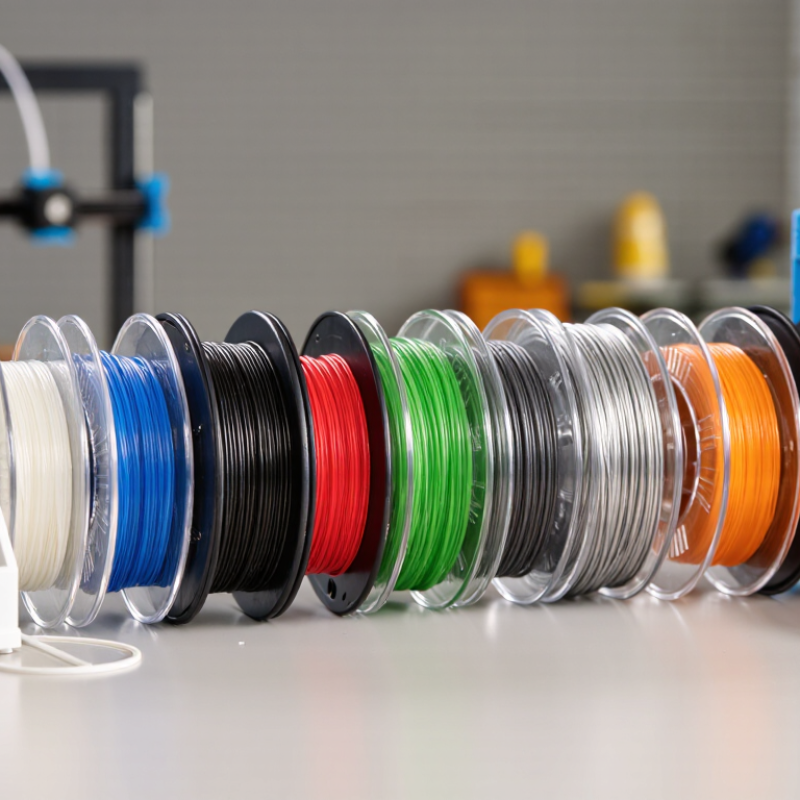
Top 10 Best 3D Printer Filaments for Every Need

Set Filament Selection Criteria with ASTM D638 Strength and ISO 75 Heat-Deflection Tests

A filament’s strength rating only matters when it matches the part’s job. ASTM D638 measures tensile properties by pulling a prepared specimen until it stretches or breaks. Compare results only when test conditions, specimen preparation, and print direction are similar. A flat printed strip may behave very differently from a part loaded across its layers. Small details matter.

Tips: Check whether the data describes molded or printed specimens. Note the print orientation, infill, and test temperature. Keep the test report nearby.

For parts that may warm up, check heat-deflection temperature measured under ISO 75. This test records when a specimen bends by a specified amount under a defined load and heating rate. It is not a guaranteed safe-use temperature. A bracket near a warm motor may soften sooner under constant stress than a test sheet suggests. Leave a margin below the reported value, then test a sample in the actual setup. It is tempting to rank filaments by one number, but that can hide weak layer bonding or poor impact behavior. Neither test captures every real-world failure. Look at both results, print a small trial part, and inspect how it deforms under load and heat.

Compare PLA, PETG, ABS, and ASA Using Typical 190–260°C Nozzle Ranges

A filament’s nozzle range is a starting point, not a promise of perfect results. PLA commonly prints around 190–220°C, making it forgiving for small models and quick prototypes. At the cooler end, layers may look weak or uneven. A modest temperature increase can improve bonding, though too much heat may soften fine details. Watch the first layers and adjust in small steps.

PETG typically uses about 220–250°C. It can produce sturdy parts, but stringing may appear between travel moves. A dry spool and slower travel can help; neither is a guaranteed fix. ABS usually needs roughly 230–260°C, plus a warm, stable build area to reduce warping. ASA shares a similar 240–260°C range and is often chosen for better outdoor durability. Ventilation matters when printing either material.

Check the filament’s own guidance before relying on these ranges. Hotend design, nozzle size, and cooling can shift the best setting. A temperature tower gives useful evidence: look for clean bridges, sharp corners, and bonded layers. Small differences show up. I still find that one setting can behave oddly after a spool has absorbed moisture, so temperature alone may not explain a rough print.

Evaluate TPU, Nylon, PC, PVA, HIPS, and Composites by Flexibility, Moisture, and Support Data

Filament choice depends on the job, not a single strength number. TPU bends around a tight curve, but its Shore hardness and print speed affect how soft the finished part feels. Nylon handles repeated stress well; it also absorbs moisture from room air. Damp filament may pop at the nozzle and leave a rough, weak surface. Dry it according to its supplier’s guidance, then store it sealed. Small details matter.

Polycarbonate is stiff and heat-tolerant, yet it often needs a warm, stable printing environment to limit warping. PVA can dissolve in water and support complex overhangs, but humidity can make it unreliable before printing. HIPS is another support option; check that the main filament and support settings are compatible. Composite filaments containing fibers can add stiffness, though they may wear a standard nozzle faster.

Compare datasheets for hardness, tensile strength, moisture guidance, and support compatibility. Those figures are useful, not guarantees. A short test print can reveal stringing, poor bonding, or support marks that a chart misses.

I still find support removal less predictable than the spec sheets suggest.

Test first.

Rank the 10 Filaments Using ASTM/ISO Strength, Heat, and Impact-Test Measures

Top 10 Best 3D Printer Filaments for Every Need

A balanced ranking weighs tensile strength, heat resistance, and impact performance rather than one headline number. The provisional order is:

1 PEEK, 2 PEI, 3 polycarbonate, 4 carbon-fiber nylon, 5 nylon, 6 ASA, 7 ABS, 8 PETG, 9 PLA, 10 TPU.

It favors engineering filaments overall; TPU would rank much higher for flexibility and impact absorption.

ASTM D638 and ISO 527 tensile-test datasets commonly place printed PLA around 45–65 MPa, PETG around 35–55 MPa, and ABS around 30–50 MPa. These are typical reported ranges, not guarantees. ASTM D256 and ISO 179 measure impact, while ISO 75 assesses heat-deflection temperature. Results shift with print direction, infill, moisture, and test temperature. A strong flat sample may split along its layer lines.

Tips: Compare specimens printed and conditioned alike. Check the test method, not just the material label. Heat resistance matters near a hot dashboard; impact strength matters when a part may hit a hard floor. The ranking has limits: published datasets do not always test all ten materials under identical conditions.

Match Filament Grades to Applications Using Published Datasheet Values and Limits

A filament’s label is only a starting point. Compare published datasheet values with the part’s actual job. For a desk organizer, PLA may be sufficient if heat exposure is low. For a bracket near a warm motor, check heat-deflection temperature and service limits. A higher number is not automatically better.

Read the test conditions, too. Tensile strength can vary with print direction, layer adhesion, and specimen preparation. A datasheet value from a molded sample may not predict a printed part’s performance. Check elongation at break for clips that must flex, and impact data for parts likely to take a knock. Numbers need context. Keep a small margin below stated limits.

Match processing requirements to your printer and routine. Nylon can suit wear-resistant components, but moisture control matters; damp filament may hiss and leave a rough surface. Flexible filament can make grips or seals, though its hardness, feed path, and stated temperature range need checking. I would also test a small sample before committing to a long print. That step feels tedious. It can expose warping, weak layer bonds, or poor fit before those flaws reach the finished part.