

Toll Free: 1800 3000 6222
Telephone: +91 141 222 3221
Fax: +91 141 222 1926, 222 2259
CIN: U29130WB1946PLC013643
Founded in 1946, National Engineering Industries Ltd (NEI) is India’s leading bearings manufacturer and exporter, renowned for excellence in quality and delivery.

Choosing among the 2026 best electric recliner chairs takes more than comparing upholstery and price. Global buyers must also weigh seat dimensions, motor noise, lift assistance, voltage compatibility, delivery access, and after-sales support. A chair that looks generous online may barely clear a narrow doorway. Comfort is personal.
The World Health Organization’s ageing and health fact sheet projects that one in six people worldwide will be aged 60 or older by 2030. That demographic shift makes accessible seating increasingly relevant, though age alone does not determine anyone’s needs. Grand View Research’s home-furniture market analysis offers useful category context, but broad furniture estimates do not isolate power recliners consistently. So, market size figures should be treated cautiously, not as proof that one model suits every buyer.
Ergonomics expert Dr. Alan Hedge of Cornell University offers a useful reminder: “The best posture is always your next posture.” It is a simple idea, and recliners cannot replace movement or individualized clinical advice. This guide compares electric recliners through practical details: control placement, footrest reach, cushioning, frame construction, and everyday ease of use. We use “Electric Chair” here to mean a powered recliner. A few trade-offs remain imperfect; softer padding, for example, may feel inviting at first but offer less support over time. The best choice is the one that fits the room, the user, and the routine—not just the product photo.
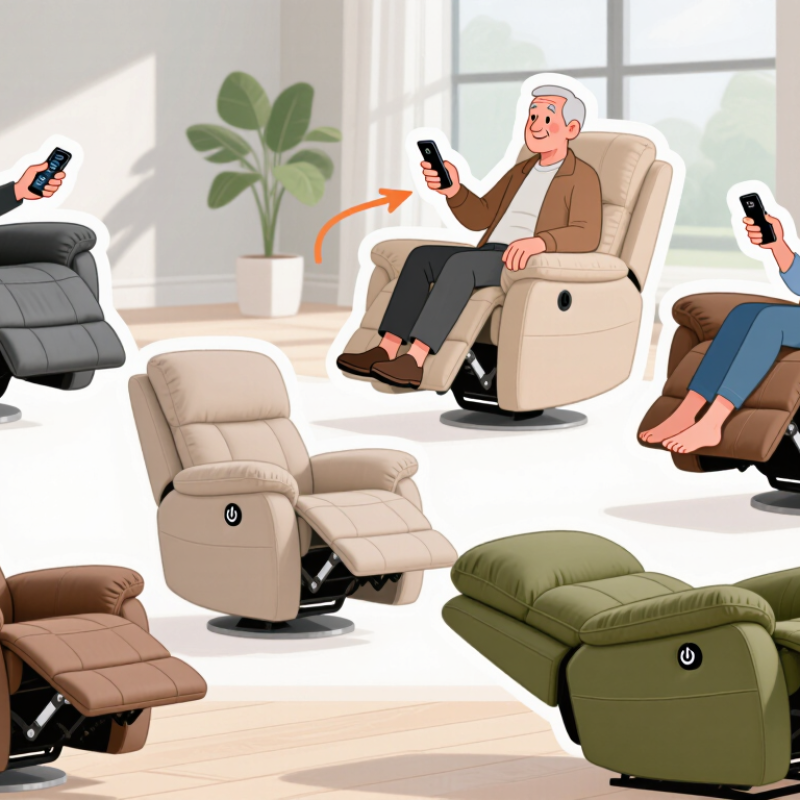
For global buyers comparing electric recliner chairs in 2026, inspect the mechanism, not just the upholstery. A typical chair combines a steel frame, linkages, one or more linear actuators, a control handset, and a low-voltage power supply. The actuator pushes or pulls the linkage to move the backrest and footrest. Single-motor designs often coordinate both sections; dual-motor designs let users adjust them separately. More motors do not automatically mean better comfort. Poorly aligned linkages can still cause uneven movement.
Motor choice shapes the operating modes. A standard actuator supports powered reclining and returning upright; a lift function uses a separate movement path to help raise the seat. Some models offer preset positions, while others stop wherever the user releases the button. Check rated load, travel range, noise, and duty cycle in the technical sheet. Small details matter. The U.S. Department of Energy’s 2002 motor-systems assessment found motors used roughly two-thirds of U.S. manufacturing electricity; that industrial figure is not a recliner benchmark, but it highlights why proper motor sizing matters. IEC 60335-2-116 also addresses safety for furniture with electrically motorized parts. A caveat: test reports rarely capture years of daily wear, so ask about cycle testing and serviceable components.

For global buyers, an electric recliner’s power rating matters as much as its comfort. A chair designed for 120 V/60 Hz may not operate correctly on a 230 V/50 Hz supply. Check the rating plate and power-adapter label before ordering. Check the label.
Some recliners use a low-voltage DC motor supplied by an external adapter. In that case, the adapter must accept the destination country’s input voltage and frequency, while providing the chair’s specified output. A plug adapter changes the plug shape only; it does not convert voltage. Plug shape misleads. If a separate transformer is needed, confirm that its capacity can handle the motor’s operating load and startup demand.
Ask the seller for written confirmation that the exact chair configuration supports your local supply. Request clear details for input voltage, frequency, output, and plug type. A product listing that says “international” may still leave important details unclear. I would also keep a photo of the rating label and the electrical specifications with the order records. It is a small step, and easy to overlook, especially when comparing fabrics and reclining positions. Worth checking.
For global buyers, seat dimensions matter more than a chair’s overall footprint. Check seat width, usable depth, and floor-to-seat height against the intended user’s body and mobility needs. A seat that looks roomy may still press against the thighs, while an overly deep cushion can leave shorter users without back support. Measure the available space, too. Include doorways, lift interiors, and the chair’s full reclined length. Measure twice.
Recline range affects both comfort and room planning. Compare the upright position with the maximum recline, and confirm whether the footrest and backrest move independently. A few extra degrees are not automatically better; the best position lets the user rest without sliding forward or straining to stand. Wall clearance varies by mechanism, so use the manufacturer’s stated measurements rather than guessing from a product photo. Photos can be misleading.
Weight capacity should be treated as a firm operating limit, not a comfort rating. Check the stated maximum and whether it refers to the user’s weight alone. Leave a practical margin when possible, especially for frequent daily use. Specifications may use inches and pounds, while buyers elsewhere expect centimetres and kilograms; convert carefully and verify rounded figures. I have seen shoppers focus on upholstery first. That choice is understandable, but dimensions and capacity are harder to correct after delivery.
Fit and Function: Seat Dimensions, Recline Range, and User Weight Capacity
The bars show illustrative planning benchmarks—not verified specifications for particular chairs. As a starting point, compact, standard, and wide recliner profiles may be compared around 300, 350, and 400 lb capacity, respectively. Common seat widths are approximately 18–22 inches, while recline angles often reach roughly 135–160 degrees; actual dimensions and limits vary by model. Check the manufacturer’s specifications, measure the intended space, and choose a capacity above the user’s weight.
For a powered recliner, ask for test evidence covering the complete chair, power supply, wiring, and controls. UL 962 addresses household and commercial furnishings, including electrically powered furniture; verify the certificate’s scope and model match. A familiar-looking label is not enough. NFPA’s Home Fires Involving Electrical Distribution and Lighting Equipment report estimated 32,620 U.S. home fires annually during 2015–2019. These figures cover electrical equipment broadly, not recliners alone, but show why sound testing and traceable documentation matter.
For EU sales, CE marking indicates the manufacturer’s declaration of conformity with applicable EU requirements; it is not a universal safety certificate. Check which rules apply to the chair and its power adapter, including electrical safety and electromagnetic compatibility. Requirements differ by destination. Confirm local voltage, frequency, plug type, language on labels, and accepted conformity documents before shipment. A chair tested for one market may still need different documentation or a compatible adapter elsewhere.
Tips: Request the full test report, not only a logo or declaration. Match its model number to the chair’s rating plate. Inspect cable routing around the moving footrest; pinched wires can be easy to miss. When rules are unclear, ask a qualified local compliance professional. UL 962 and CE marking are useful checkpoints, not substitutes for checking destination-market requirements.
| Market | Typical Mains Supply | Key Safety and Compliance Considerations | Documents and Checks for Buyers | Practical Importer Checklist |
|---|---|---|---|---|
| United States | Typically 120 V AC, 60 Hz. Some powered chairs use a low-voltage DC adapter connected to mains power. | UL 962 is a standard for household and commercial furnishings and may be relevant to powered furniture. Whether a particular chair or component needs evaluation depends on its design, intended use, and applicable local requirements. A UL mark is not, by itself, a universal legal requirement for every sale. | Request the applicable test or certification documentation for the complete chair and its power supply. Confirm that the model, electrical ratings, and supplied components match the documents. | Check the destination state, local electrical code, retailer requirements, plug type, and whether the chair is supplied with a power adapter suitable for 120 V, 60 Hz. |
| Canada | Typically 120 V AC, 60 Hz. | Electrical products generally need to meet applicable Canadian requirements. The required approval route can depend on product classification, province or territory, and the authority having jurisdiction. US-only documentation should not automatically be assumed to satisfy Canadian requirements. | Request Canadian-market safety documentation for the chair and its power supply, and verify that any certification or approval applies to the exact model and configuration. | Confirm provincial or territorial requirements, accepted approval marks, cord and plug configuration, and the input ratings printed on the power supply. |
| European Union and EEA | Commonly 230 V AC, 50 Hz; socket and plug arrangements vary by country. | CE marking is the manufacturer’s declaration that applicable EU requirements have been met; it is not a general third-party safety certificate. Depending on the product and configuration, relevant rules may include the Low Voltage Directive 2014/35/EU, EMC Directive 2014/30/EU, and RoHS Directive 2011/65/EU. The Low Voltage Directive voltage thresholds are 50–1,000 V AC and 75–1,500 V DC, so a low-voltage chair and its mains adapter may have different assessment considerations. | Request the EU Declaration of Conformity identifying the product and applicable legislation, plus supporting technical or test documentation. Check that the declaration covers the supplied adapter and intended configuration where applicable. | Confirm the correct country-specific plug, local-language instructions and safety information, traceability details, and any additional national requirements. |
| United Kingdom | Typically 230 V AC, 50 Hz; commonly a BS 1363 plug for household outlets. | Check the UK product-safety, electrical, EMC, and substance-restriction rules applicable to the product. CE or UKCA marking acceptance can depend on the applicable product rules and current government policy; confirm the accepted route for the specific goods and market before shipment. | Request the relevant conformity declaration and safety evidence for the chair and mains adapter. Confirm that the documents identify the exact model and applicable UK requirements. | Check Great Britain versus Northern Ireland requirements, plug and fuse configuration, instructions, importer details, and current marking rules. |
| Australia and New Zealand | Typically 230 V AC, 50 Hz; Type I plugs are commonly used. | Electrical safety and EMC obligations depend on the product, risk classification, and applicable national or state arrangements. In Australia, the Regulatory Compliance Mark (RCM) is used for relevant supplier compliance obligations; not every product follows the same registration or evidence pathway. Confirm New Zealand requirements separately. | Request evidence showing the applicable electrical safety and EMC assessment, and verify any required supplier registration or product records for the destination market. | Confirm local supplier responsibilities, product classification, Type I plug, ratings, and whether the exact chair and power supply are covered by the compliance evidence. |
| Japan | 100 V AC, 50 Hz or 60 Hz, depending on location. | Requirements under Japan’s Electrical Appliance and Material Safety Act depend on product classification. A chair and its separate power adapter may be treated differently; do not assume that the complete furniture item is subject to the same requirements as the adapter. | Request a classification assessment and applicable compliance evidence for the product and power supply. Check whether any regulated component requires PSE marking and related documentation. | Verify regional frequency compatibility, Japanese-language information where required, plug configuration, and the adapter’s 100 V input rating. |
Buyer note: Electrical requirements depend on the chair’s design, power source, included accessories, product classification, and destination market. Confirm current rules with the relevant local authority or a qualified compliance professional before importing or selling. Never rely on a voltage converter to correct an incompatible frequency, plug, or product safety approval.
An electric recliner can look affordable until a motor fails far from the seller’s service network. Read the warranty before comparing prices. Check how long the frame, motor, controls, and upholstery are covered; these parts may have different terms. Ask who pays for return freight and whether replacement parts can be shipped to your country. Get the answers in writing. A long warranty is less useful if support takes weeks to respond. Confirm service hours, language options, and whether a local technician can access repair instructions.
Shipping needs its own checklist. Request the packed dimensions and weight, not just the chair’s measurements. Measure doorways, stairs, and lift access at the delivery address. Confirm whether delivery includes room placement, assembly, and packaging removal. Also verify the chair’s electrical requirements; do not assume a plug adapter solves voltage differences. Then estimate total cost of ownership: purchase price, freight, customs charges, setup, electricity, and likely repairs. Exact repair costs can be hard to predict. That uncertainty deserves a small budget. A low quote may still be the wrong choice when spare parts are slow to arrive or a bulky return is expensive. Compare written estimates, and leave room for details you may have missed.
Copyright © 2023 NEI Ltd. All rights reserved.
Registered Office : 9/1, R. N. Mukherjee Road, Kolkata – 700 001. In case of any queries or grievances, please contact Mr.Tarun Kumar Kabra, Company Secretary.
E-mail: sale@kinpart.com Privacy Policy Cookie Policy